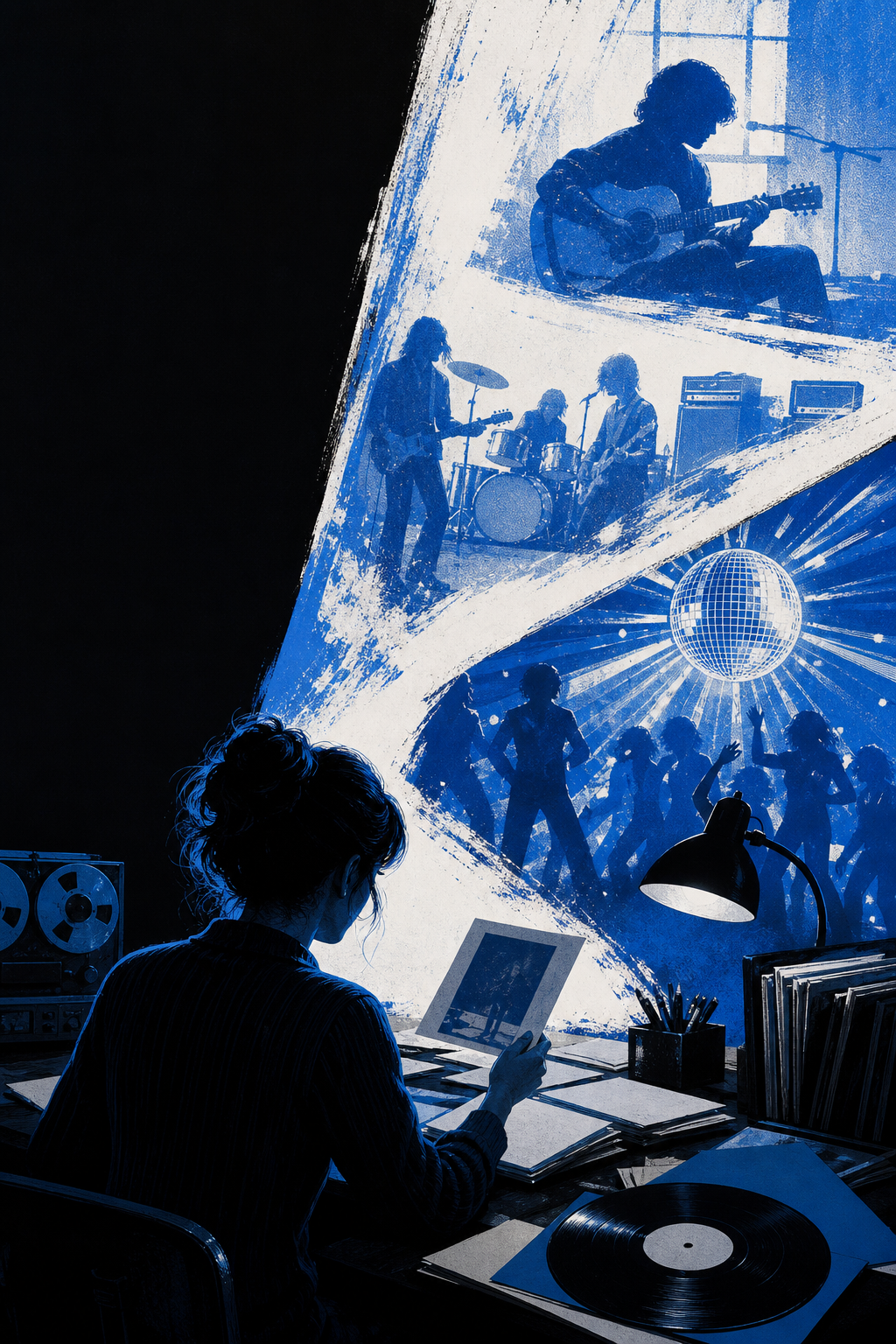
Chapter 4
The Song Leaves the Office
By the end of November, the office had stopped treating the record as a visitor.
It played from the back room while we stamped invoices, argued over cartons, and tried not to spill coffee on dispatch sheets. Brown boxes arrived with crooked Aquarius labels. Inside were 45 tours in paper sleeves and larger maxi-45s for clubs.
Luc carried a carton against his hip.
— Careful, he said. That may contain our escape from warehouse work.
— It contains twenty-five records.
— Twenty-five chances, then.
The French release was commonly dated to November, though our paperwork could not agree on which day or format reached which shop first. The record was already moving beyond Paris while we corrected addresses.
Luc read his sheet. “Lyon. Marseille. Brussels. Three shops, two radio people, and a club with no telephone number.”
— How do we contact a club with no telephone number?
— We send them a record. Advanced system.
He held up a maxi-45. “Twelve inches of hope.”
— Twelve inches of room for a longer version.
— You are learning logistics.
— I am learning that DJs hate being told when to stop.
— That is practically the same thing.
A week later he took me to a discothèque near the river. The walls sweated smoke and perfume under colored lights. The DJ worked behind two turntables, headphones, and a tower of record sleeves. Luc handed him a copy without a speech, which I knew cost him effort.
The DJ read the label, lifted one eyebrow, and set down the needle.
At first the record fought the room: glasses clinked, someone shouted for a drink. Then its pulse found the floor. People changed their steps without noticing. The repeated hook rose above the noise, and a woman near the bar sang along to words she could not yet know.
The DJ let it run, moved on, then returned to it later.
— That second time was the test, I said.
— The first time is curiosity, Luc said. The second is work.
Outside, the river air felt thin after the heat.
— They do not care whether you find your missing draft, Luc said.
— They might care that the song was not made for this room from the beginning.
— They care whether it works in the room now.
— That is not the same question.
— No. But it gets records ordered.
In January, Delorme put a typed page on his desk between us. Its proposed headline read: BORN IN DISCO. MADE FOR THE WORLD.
— Your feature, he said. One page for the next promotional mailing.
The first paragraph called “Born to Be Alive” a disco song created for dance floors.
— You want me to sign this?
— I want you to make it readable.
— It is readable. It is wrong.
Delorme sighed. “Camille.”
— The song existed before this version. Hernandez later recalled writing it in 1973, around Pigalle. The earliest version we can document was acoustic and folk-like.
— And you cannot produce it.
— No.
— Then do not build the piece around a ghost.
I nearly gave in. I had spent months chasing evidence absent from our office, old studio contacts, and stories reshaped by success. I was tired of qualifying every sentence, tired of being the girl with a pencil arguing with men who had telephones, contracts, and deadlines.
For two days, I tried to make Delorme’s story true enough to print. I wrote that the song had “found its natural home in disco.” I called its earlier life “a rough sketch,” though I had no right to reduce it that way. I wrote that the record had been built for international dance floors.
Luc read the draft over a sandwich.
— This one sells, he said.
— That is not praise.
— It is not an insult.
— It makes the earlier version sound like an inconvenience.
— It was an inconvenience. Unreleased project, unpaid studio, band breaks up. Then this works.
— Failure does not make it irrelevant.
— Neither does history make a carton move.
We did not speak that afternoon.
By spring, foreign orders made the office louder. Reports came from European markets in scraps: a trade notice, a message with Hernandez’s name misspelled, a shopkeeper asking for more sleeves.
Then, in May, Luc dropped an American trade paper on my desk.
— Your history problem has crossed the Atlantic.
The European recording had been acquired for U.S. distribution through A-Tom-Mik and CBS. It had been remixed and extended to seven minutes and twenty-seven seconds for discos and DJ programming.
Luc marked the line in blue pencil. “Seven twenty-seven. That is what they want over there.”
— That is what that market wants.
— You hear the difference because you enjoy making life difficult.
— No. I hear it because it is a different version.
At the dispatch table, two club packages had the wrong notes: DJs were being promised the extended American mix while receiving European copies.
Luc stared at the forms, then the cartons. “That is not my handwriting.”
— It is still your shipment.
For an hour we opened boxes, replaced slips, and called the contacts we could reach. Luc did most of the lifting; I did most of the apologizing.
Near closing, he sat on an upturned carton.
— All right, he said. Versions matter.
— They do.
— But people dancing matter too.
I sat beside him. “More than I understood.”
— A song does not travel because somebody writes a perfect paragraph about it.
— No. But if we tell people which record they have, we should not pretend it was always that record.
He smiled for the first time since our argument.
In August, the British report arrived: fourteen weeks on the Official Singles Chart, peaking at No. 10. Delorme pinned it by the telephone. The office spoke of the record as if it had always been inevitable.
Then he summoned me.
— I have read your revised feature.
I had abandoned the false opening. The piece began with the release, then asked which “Born to Be Alive” listeners meant: the French single, club format, later American remix, or older song beneath them.
— This is not promotional copy, Delorme said.
— No.
— It will not go with the main campaign.
The campaign meant wider circulation and the freelance fee he had hinted at in January.
— What will happen to it?
— I can run it in the trade circular. Small type. Your name, if you insist. No fee. Then you return to office work. No more features until you learn the difference between a release note and a courtroom.
The easy version waited in his drawer. I could sign it and keep my place near the work I wanted.
Instead, I crossed out my name and handed it back.
— Print the other one.
Delorme studied me. “You have chosen the smaller room.”
— I know.
Later that year, the American figures reached us: No. 1 on Billboard’s National Disco Action chart and No. 16 on the Hot 100. Luc brought cheap wine to the back room, and we drank from paper cups after the telephones stopped ringing.
— To cartons, he said.
— To the people who chose the record twice, I said.
— And to the girl who made me reopen six boxes.
— That was teamwork.
My article appeared beneath advertisements and price lists. Luc had to lean close to read my name.
Its final line did not claim to solve the song’s beginning. It said the hit had not appeared fully formed on a disco floor. An older song had survived failure, been remade for a new use, then carried farther by people who pressed it, shipped it, played it, and danced to it.
On my way home, I passed the club by the river. The record thudded through its wall and into the pavement.
Behind that beat was a beginning I could not recover.
Not a blank to decorate. Not a mystery I had conquered.
Just the part of the story out of reach—and the reason the rest was worth telling.