Chapter 1
The Blank Page
The first thing Monsieur Delorme asked me to find was a beginning.
— Not a biography, he said, dropping a thin folder onto my desk. One page. Something journalists can use.
The folder landed among invoices, telephone messages, and cream-colored sleeves stamped AQUARIUS in blue. Behind us, a test pressing turned on the office player. The beat was bright and steady against the wet November light.
— Patrick Hernandez, Delorme said. The new single. Where did it come from? Who had the idea? Why disco?
— The usual questions.
— The useful questions. He tapped the folder. Give them a line they can remember. Born in the clubs. Made for the world.
Then he walked away, leaving me to decide whether a memorable line had to be true.
Luc Renard leaned over the partition, a carton of singles against his hip. His tie had slipped sideways, as it always did by noon.
— Born in the clubs, he said. Efficient. Saves everyone the inconvenience of having a past.
— You think this one does?
— It has a singer, a beat, and two sides of vinyl. That is a complete family tree for most people.
A sleeve slid from his carton. I caught it before it hit the floor. Patrick Hernandez stared from the cover with the determined expression of a man who did not expect to be filed alphabetically.
— I’ve heard it twice, I said. It doesn’t sound new.
Luc raised an eyebrow. “Compliment or insult?”
— It sounds as if something existed before this arrangement.
— Listen to her. We employ one clerk and one detective.
I opened the folder. It held publicity photographs, a release schedule, foreign telephone numbers, and a typed paragraph calling the record “an irresistible new disco sensation.” Jean Vanloo’s name appeared on production papers. Nothing explained what came before the current record.
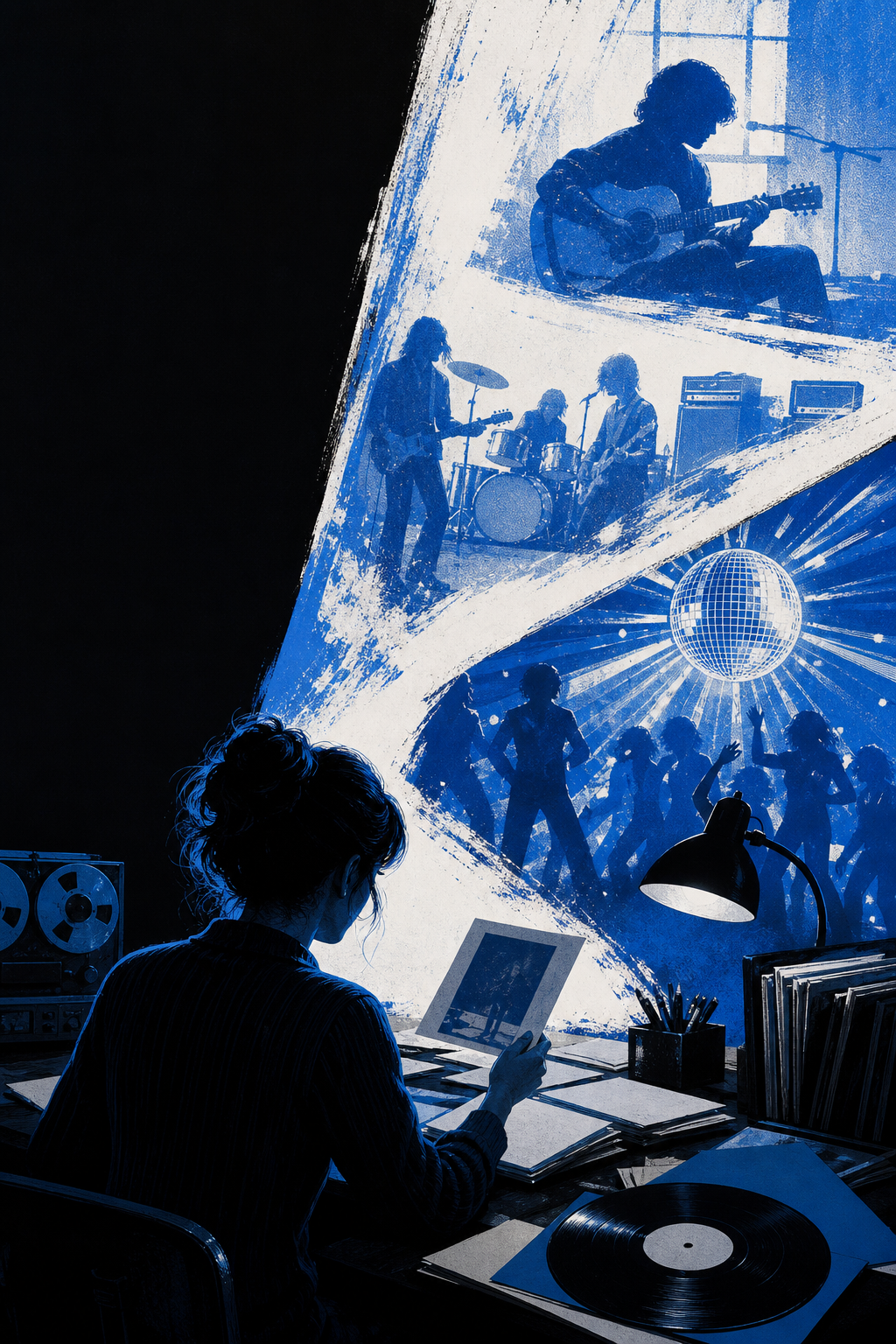
I wanted an object: a notebook page, a dated tape box, a lyric sheet folded into somebody’s drawer. If I found the first artifact, the story would arrange itself around it—composition, recording, reinvention, release. A clean line from a room in Paris to a dance floor.
By lunch I had opened every drawer assigned to old publicity material. I found contracts, photographs, a complaint about sleeves delivered without records, and a message from Brussels requesting more French copies. In the tape cupboard, boxes bore labels such as PPH—DEMO, STUDIO 92, and MIX—AQUARIUS.
None said BORN TO BE ALIVE—FIRST DRAFT.
— Careful, Luc said as I crouched before the lowest shelf. If you find a priceless original tape, don’t leave it near the heating pipe. That pipe has destroyed three singers and a Christmas compilation.
— I’m serious.
— So is the pipe.
By four, I had found no manuscript, dated lyric sheet, acoustic tape, or technical notes. I drew a rectangle in my notebook and wrote: FIRST VERSION.
Luc looked over my shoulder.
— That’s your article?
— That’s where the evidence will go.
— It looks empty.
— It won’t be.
An empty box was not a beginning. It was a failure of filing, and I intended to correct it.
The next morning, after I asked twice and pretended not to be nervous, Delorme’s secretary gave me a telephone number.
The line clicked, rang, then stayed silent long enough for me to regret every question I had prepared.
When a man answered, I introduced myself, named the office, and explained that I was assembling background notes.
— Background notes, he repeated.
— For a song people are already dancing to?
— They may want to know where it came from.
A pause followed—the pause of a man deciding how much of his past could safely be handed to a stranger with a pencil.
— It came from before this record, he said.
— Before disco?
— Before this arrangement.
My pencil tightened. “Was there a recording?”
— There were things. Ask around Paris Palace Hotel.
The name meant little to me then. I wrote it in the margin.
— Could you tell me what the first version sounded like?
— You are asking for a long answer on an expensive telephone line.
— I’m sorry.
— You should speak to people who were there.
He gave me no date and offered no tape. He was polite enough, but had sent me away with a group name and a door half-open.
Only years later, when I compared my notes with Patrick Hernandez’s public interviews, could I fill in some of what that exchange had not supplied. In later recollections, he placed the song’s beginning around Pigalle in 1973. He described it as simple, acoustic, and folk-like—not disco—and said its central idea came from anger at people content to live only halfway: in love, work, friendship, everything.
At the time, I did not understand how carefully I would need to hold those details. A songwriter’s memory felt close to proof. It had a voice and a name. I wanted it to fill the empty rectangle.
There was another recollection I would later note: Hernandez said he had considered the phrase “Born to Be Wild,” then changed it because Steppenwolf already had a famous song by that title. In 1978, it sounded like a clue from a missing draft.
But even he was careful. Considering a phrase, he made clear, was not the same as possessing a page with that phrase written on it.
I wrote:
POSSIBLE ORIGINAL TITLE?
The question mark was small enough to ignore if I needed to.
I tried Delorme’s sentence first.
Patrick Hernandez’s “Born to Be Alive” is a new disco anthem, created for the clubs and destined for the world.
It was smooth. It made the record seem inevitable.
Delorme read it standing over my desk. He crossed out “destined for the world.”
— Who says that?
— No one. It’s promotional language.
— Then use less of it. We are selling a record, Moreau, not a prophecy. He tapped the first half. And ‘created for the clubs’? Can you prove it?
— Not yet.
— Then find out. A journalist will ask where it came from, and I do not want our answer to sound like we invented it yesterday.
It was not a lecture about truth. Delorme cared about being contradicted in print. Still, the order gave me room to keep digging.
On a fresh page, I tried again.
Patrick Hernandez’s new single developed from earlier work connected to Paris Palace Hotel. Further details are being sought.
Delorme grimaced. “This says nothing.”
— It says what I know.
— It says what you do not know. Find a date. Find a tape. Find somebody who remembers. Make it a story by Friday.
After he left, Luc set a cold coffee beside my elbow.
— Well?
— He wants certainty.
— He wants a sentence that can stand by itself.
— I need one thing that stands still first.
Luc nodded toward my empty rectangle. “You think there’s a tape.”
— There has to be something.
— Why?
— Because songs do not simply appear.
— They do if nobody keeps the boxes.
I stared at the folders, sleeves, and untouched tape cupboard. I still believed the missing object would rescue me: a first version that could settle the dates, title, sound, and untidy route before disco.
Luc picked up the folder and saw the name in my margin.
— Paris Palace Hotel, he said. Sounds expensive.
— It sounds like a place people forget to leave.
— Then perhaps your tape is still checked in.
At the top of a clean page, I wrote:
THE FIRST DRAFT
Under it I listed what I needed.
A date.
A tape.
A witness.
A title.
Then I closed the notebook before the blank beneath the list could show me how little I understood about beginnings.