Chapter 3
A Different Kind of Pulse
The question mark stayed in my file, but it no longer stopped the work.
On Monday, I moved it to the margin and began a fresh page.
1978—what changed?
Below it, I wrote three names.
Patrick Hernandez.
Jean Vanloo.
Hervé Tholance.
Luc leaned over the partition with record sleeves under one arm.
— Suspects?
— Collaborators.
— Same thing, except collaborators leave better invoices.
Vanloo wanted me at the studio. Delorme had warned me: “You listen. Do not touch equipment, ask questions during takes, or write anything that makes us look foolish.”
— I can promise the first two.
By three, I stood outside a studio near the river with a visitor’s pass marked in red pencil. Inside smelled of hot wires, coffee, dust, and cigarette smoke. A tape machine turned behind the control-room glass.
Jean Vanloo sat at the console. Patrick Hernandez stood by a microphone, arms folded. Hervé Tholance adjusted a guitar strap near an amplifier.
Vanloo studied my pass. “Records office?”
— Camille Moreau.
— Sit there, Camille. Listen.
The tape began.
The title was familiar, but its surroundings were not. A guitar entered, then dropped away. Drums held a blunt, regular pulse. The bass stayed beneath the vocal instead of wandering after it. The arrangement felt open, as if the song had rooms not yet furnished.
Vanloo stopped the tape before a minute had passed.
— No.
Nobody answered.
He rewound to the opening. The first vocal line arrived, then the rhythm fell away behind it.
— There, he said, tapping the console. It disappears.
Hernandez shook his head. “It’s the verse.”
— It is a verse standing alone.
— It has always stood alone.
— That is the problem.
Hernandez’s mouth tightened. “You want it to march.”
— I want people to know where they are when it starts.
Tholance lowered his eyes and turned a guitar peg. He looked like a man who had heard this argument before.
I did not know how much belonged to that afternoon and how much later memory would sharpen it. Years afterward, Hernandez said he had resisted the disco proposal. His instincts had been pop-rock, and he did not want the song turned into a passing fashion. I could report that as his recollection. What I witnessed was simpler: a singer hearing his old song become unfamiliar.
Vanloo ran the tape again. This time the drummer entered sooner. The rhythm held through the vocal.
— Again.
The second attempt was worse. The beat was stronger, but it crowded Hernandez’s voice.
— Too much, Tholance said.
Vanloo rubbed his forehead. “Yes.”
— Now it is a machine, Hernandez said.
— It is supposed to move.
— It can move without trampling everything.
For the first time, Vanloo smiled. “Good. Then we agree on something.”
They did not, exactly. But the next hour turned one large argument into smaller problems.
The drums stayed steady, though less heavy. The bass tightened around them. A keyboard part was tried, removed, then restored in short strokes. Tholance tested guitar accents between vocal phrases instead of long rock passages. The tape stopped and backed up again and again. Each small decision exposed another.
I understood why calling this a rock song with a disco beat would be lazy.
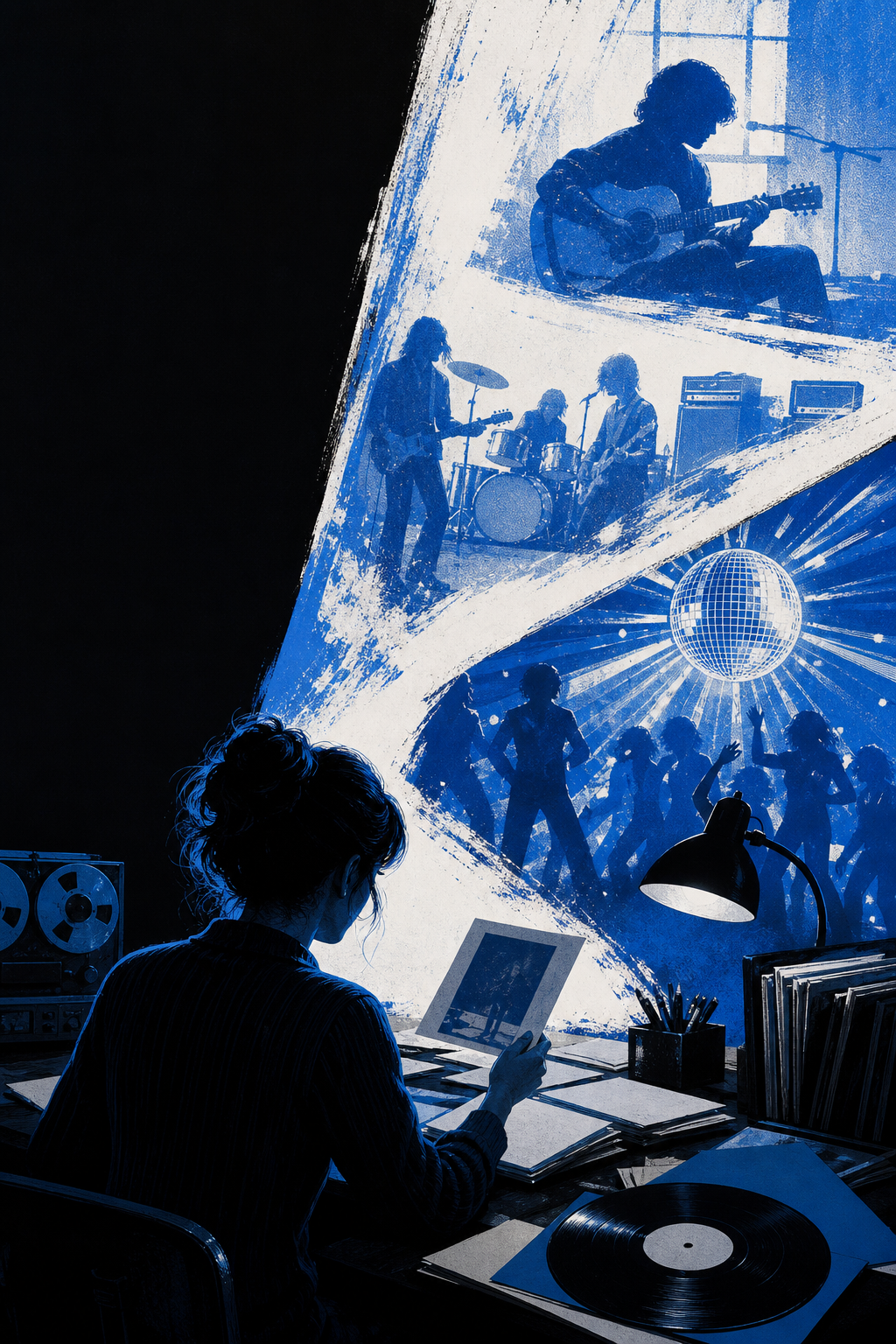
The beat changed the song’s center of gravity. So did the spaces around the vocal and the way instruments entered and withdrew. Guitar no longer had to carry the arrangement; it could flash across the rhythm, then leave it moving. Voices would later be layered behind Hernandez’s lead. Percussion, keyboards, and brass or saxophone touches would help create the polished surface of the finished record. But that afternoon, the change began with fewer things: a pulse that would not abandon the song, and a vocal learning to sit inside it.
Vanloo asked for another playback.
No one spoke while it ran.
It did not sound finished. It sounded possible.
Tholance nodded once. Hernandez did not, but he stopped folding his arms.
During a break, I sat beside my notebook.
Steadier rhythm. Less guitar-led. Vocal forward. Arrangement built in layers.
Then I crossed out built and wrote being built.
At the back of the room, a radio announcer described disco as though it had appeared from a Paris shop window with mirrors and silver trousers.
Vanloo switched it off.
— Enough.
— Afraid of competition? Tholance asked.
— Afraid of bad radio.
I thought of my office reading. Disco had not begun in French studios or Belgian production rooms. Its roots lay in Black and gay club cultures in the United States, especially New York, where DJs, dancers, and club crowds shaped its purpose through repeated play. This was a later French-Belgian adaptation, made for records, discothèques, and markets beyond them. That did not make it false. It made it part of a longer route.
Vanloo was not adding sequins to an old rock arrangement. He wanted a record that could hold a room after the first chorus, that a DJ could use without its energy collapsing, that might work as a single while leaving room for a longer dance version.
He did not say it that neatly.
Mostly he said, “Again.”
Or, “Leave that out.”
Once, after backing vocals tangled with the lead, he said, “No. It sounds like five people arguing in a lift.”
Tholance laughed. Hernandez did too, unwillingly.
Later accounts attached details to this period. Hernandez credited Tholance with devising the memorable opening guitar figure and supplying a low chorus voice. He also recalled Vanloo wanting more emphasis around the word “fine,” and said that he and Tholance jokingly suggested repeating it until repetition became part of the hook.
I did not record those as witnessed facts. I had heard guitar tested, voices added and removed, phrases replayed until their edges changed. But I had no complete session log, and one afternoon could not prove who first imagined a figure or when a joke became a decision.
In my file, I wrote:
Later recollections—attribute to Hernandez.
Still, the principle was audible. A small word could grow through repetition. A short phrase could become rhythm as well as language. The song’s new life depended not on one grand invention, but on choices made, rejected, and made again.
Near the session’s end, Delorme appeared in the doorway. He listened for perhaps forty seconds.
— There, he said. Vanloo found the hit.
I looked at my notebook.
Vanloo did not correct him. Hernandez did not either.
Perhaps they were tired.
Delorme turned to me. “That is your story.”
— It is part of it.
He frowned. “What is that supposed to mean?”
— Hernandez wrote the song. He is the lead performer. Vanloo is producing this version.
— People do not buy distinctions.
— They may buy a record because of the production, I said. That does not make the producer its songwriter.
The control room went quiet.
I was twenty, carrying a visitor’s pass and a pencil, correcting a man who could end my assignment with one telephone call.
Then Hernandez spoke.
— She is right.
Vanloo gave a small shrug. “The song was there.”
— That is not the slogan, Delorme said.
— No, I said. It is the truth.
He left without taking my notebook, which I counted as victory.
On the Métro back to the office, I rewrote my page.
Hernandez: songwriter, composer, lead performer.
Vanloo: producer; decisive advocate for disco reinvention.
Tholance: continuing collaborator from the PPH period; associated with guitar, arranging, and vocals. Specific contributions must be attributed to later recollection.
Below that, I wrote:
The new version changes rhythm, density, vocal presentation, length, and purpose. It is designed for dance floors, DJs, singles, and longer club formats—not simply for a band in a room.
The first draft remained beyond reach. I still could not name its exact words, melody, key, tempo, or chords.
But I had watched the later song struggle toward another form.
It had not become disco by putting a beat beneath an old memory.
It had been rebuilt until the beat gave that memory somewhere to go.