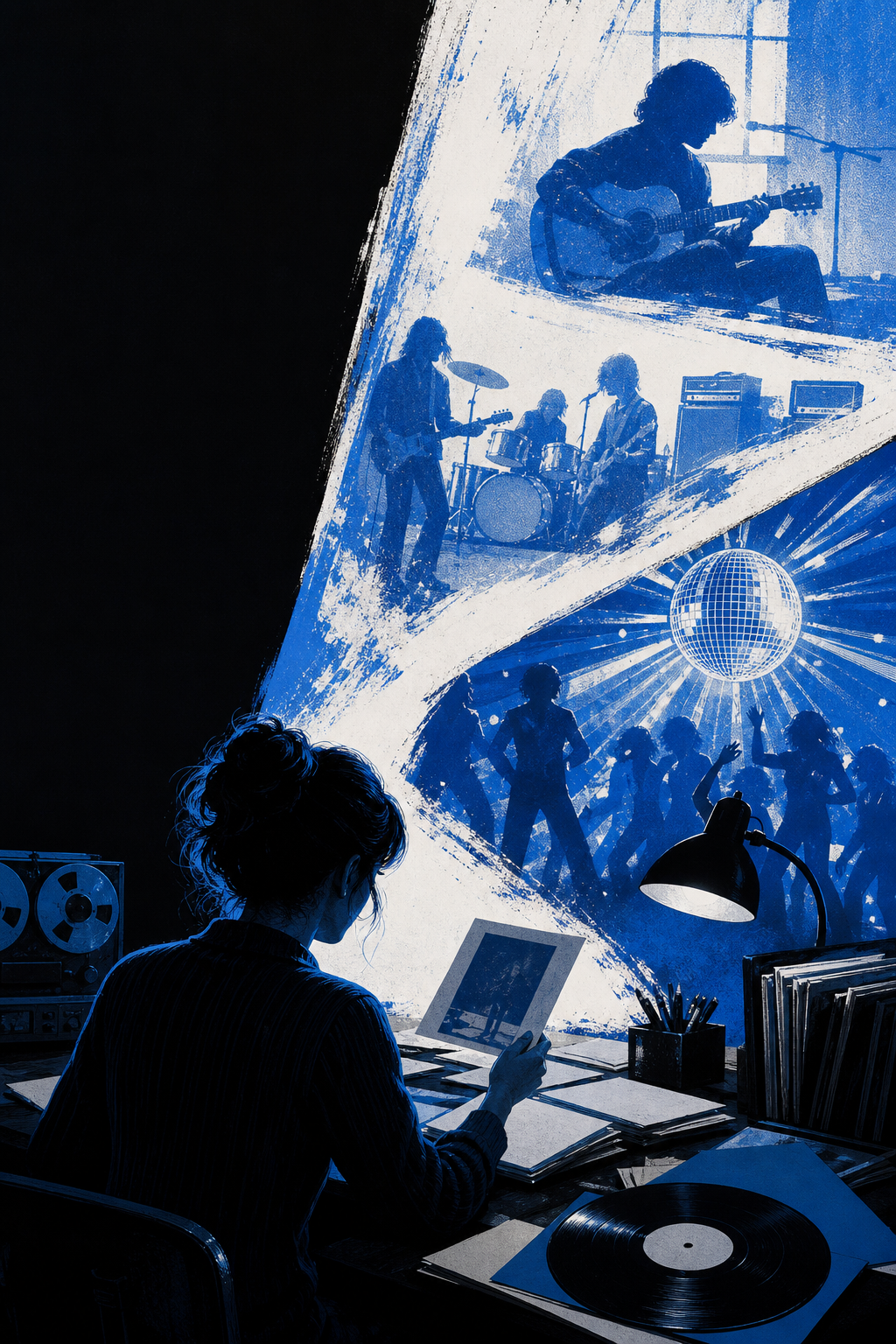
Chapter 2
The Tape That Never Arrived
The address came from Delorme’s secretary on the back of a telephone message.
— Hervé Tholance, she said. Paris Palace Hotel. He may remember something.
— May?
She glanced at the folders on my desk. “That is more than you had yesterday.”
I copied the address into my notebook and took the Métro east. On the train, I reread my questions until they sounded foolish.
When was it first recorded?
Where is the tape?
Who was there?
By the time I reached Tholance’s building, I had crossed out everything but one.
Was there ever a record?
He answered after my second knock. He was older than I expected, with tired eyes and a shirt marked by a day’s work. A guitar case stood in the narrow hall.
— From Aquarius? he asked.
— Yes. Camille Moreau. I’m tracing the earlier history of Patrick Hernandez’s song.
— The new one?
— ‘Born to Be Alive.’
He nodded and stepped aside. “Come in.”
The flat was warm and cramped. Papers covered one chair; cables lay under the table. Several tape boxes were stacked by the wall. One had PPH written on it in faded pencil.
I pointed. “Is that a tape?”
— It is a tape box.
— Does it have the song?
— If I knew that, I would not keep it under a lamp.
He set the box on the table. Its corners were bent, and most of the writing had faded. PPH remained visible. Beneath it, there might once have been a date.
— You have a machine?
— One that sometimes remembers its job.
He took a reel-to-reel recorder from a cupboard. I held the plug while he dusted the controls, set the reel in place, and switched it on.
The machine clicked.
Nothing followed.
Tholance pressed another button and turned a dial. The reels did not move.
— It could be a rehearsal, he said. Another song. Patrick shouting because somebody missed an entrance.
— Could it be this song?
— It could. That is not the same as saying it is.
The machine gave a thin mechanical cough and fell quiet.
I wrote: PPH REEL—UNPLAYABLE. CONTENTS UNKNOWN.
— That is sensible, Tholance said.
— I was hoping for something less sensible.
— So was everyone involved in that group.
He put the reel away and sat opposite me. I opened my notebook.
— Can you tell me what you do know?
— We made maquettes, he said. Demos. Rough recordings to hear what a song might become. They were not records for sale.
I had seen the word in office papers. Here, it meant something temporary, made before anyone knew whether there would be money, a studio, or a future.
— Was ‘Born to Be Alive’ one of them?
— It belonged to the Paris Palace Hotel work. The early version was simple. Acoustic. Folk-like.
— And then it became disco?
— No. First it became louder.
He rolled a guitar pick between his fingers.
— With PPH, we tried electric guitars. More rock. Guitar-led. We were listening to American rock records, California-style things. We wanted a fuller sound.
The path was less tidy than Delorme wanted: an acoustic song, a rock treatment, a failed project, and only later the dance record in our office.
— When was this?
— That depends what you mean by ‘this.’
— The demo. The rock version. The studio work.
— Some goes back to around 1973. Later, people called a more formal recording a 1975 version. He shrugged. I cannot put every rehearsal and tape into a clean year.
— But you were there.
— For parts of it. That is different.
He tapped the PPH box. “A song can be written, rehearsed, recorded as a demo, changed, then brought back months later. Nobody announces which attempt will matter afterward.”
I wrote: PPH DEVELOPMENT—EARLY 1970s. LATER ELECTRIC ROCK TREATMENT—MID-1970s, DATE UNCERTAIN.
— Keep the uncertainty, he said. Do not choose 1973 or 1975 because somebody wants a better paragraph.
— I’m trying not to.
— Good. Write what you can support.
Before I left, he gave me the name of a former contact connected with Studio 92, near Paris. He also mentioned Brussels, where PPH had made demos before the Studio 92 album project.
— Try him, Tholance said. He may remember the rooms better than I do.
The Studio 92 contact met me the next morning in a dusty office smelling of stale tobacco. He did not remember every musician or session, but he remembered the project’s end.
— Paris Palace Hotel, he said. There was an album planned.
— Was it released?
— Not in the normal way.
He searched a drawer, found nothing, and shut it.
— Studio time costs money. If bills are not paid, a tape can sit there. Then people move on. Groups break up.
— Were copies pressed?
— I cannot tell you that.
— But it was not sold as an album?
— No. Not like a proper release.
He had no catalog sheet, master tape, or ledger to settle the dates. Records had changed hands, he said. Some were discarded; some might still be in private rooms.
Back at Aquarius, Luc was sorting returned singles near the warehouse door.
— You found your lost masterpiece?
— I found out why it may be lost.
— The PPH album project was never properly released, I said. Unpaid studio costs, apparently. Then the group dissolved.
Luc stopped writing. “That will stop a record before it reaches a shop.”
We pulled old circulation lists from a cabinet: catalog sheets, invoices, stock ledgers, returns. I searched for Paris Palace Hotel while Luc checked shipments.
Nothing showed a regular single release. No cartons arriving at the warehouse. No unsold copies returning from shops.
Luc called two record stores. The first owner recognized the group name but did not remember receiving records. The second said, “If I had received boxes, I would have written them down.”
— Ask if he remembers the song, I said.
— He does not.
When Luc hung up, he leaned back.
— So that is it. Nobody bought it because nobody could.
— Not nobody. We do not know who heard it privately.
He gave me a look.
— Fine. Nobody bought it through ordinary distribution.
— That is what we can show.
At my desk, I laid out the notes.
An early folk-like maquette in the PPH period.
Demos associated with Brussels.
A later electric, guitar-led treatment.
Studio 92 work near Paris.
An album project without a normal commercial release.
Dates that would not hold still.
One old reel with a blurred label and no sound.
I drew a question mark beside the reel.
— The first draft is still missing, Luc said from the partition.
— So is the exact first PPH recording.
— But?
— But I no longer think the song went directly from a private acoustic idea to the disco record on our turntable.
It had passed through a band, demos, a louder arrangement, studio sessions, unpaid bills, and an album that never reached the public.
Under the question mark, I wrote:
NOT AN EARLY HIT. AN EARLY FAILURE THAT SURVIVED.
This time, I did not cross it out.