Chapter 3
The Street After Labor
I am writing this years after the day itself. The name “golden age” came later, with careful comparisons of records. Locke’s busiest commercial years were in the 1920s, with 1926 through 1929 at the clearest peak. On that evening in 1928, I knew only that I had a motorcycle, a notebook, and less daylight than I had meant to spend in town.
Mei’s list was in my pocket. Mrs. Chan’s account from the day before had to go back with me.
By late afternoon, Main Street had begun to change.
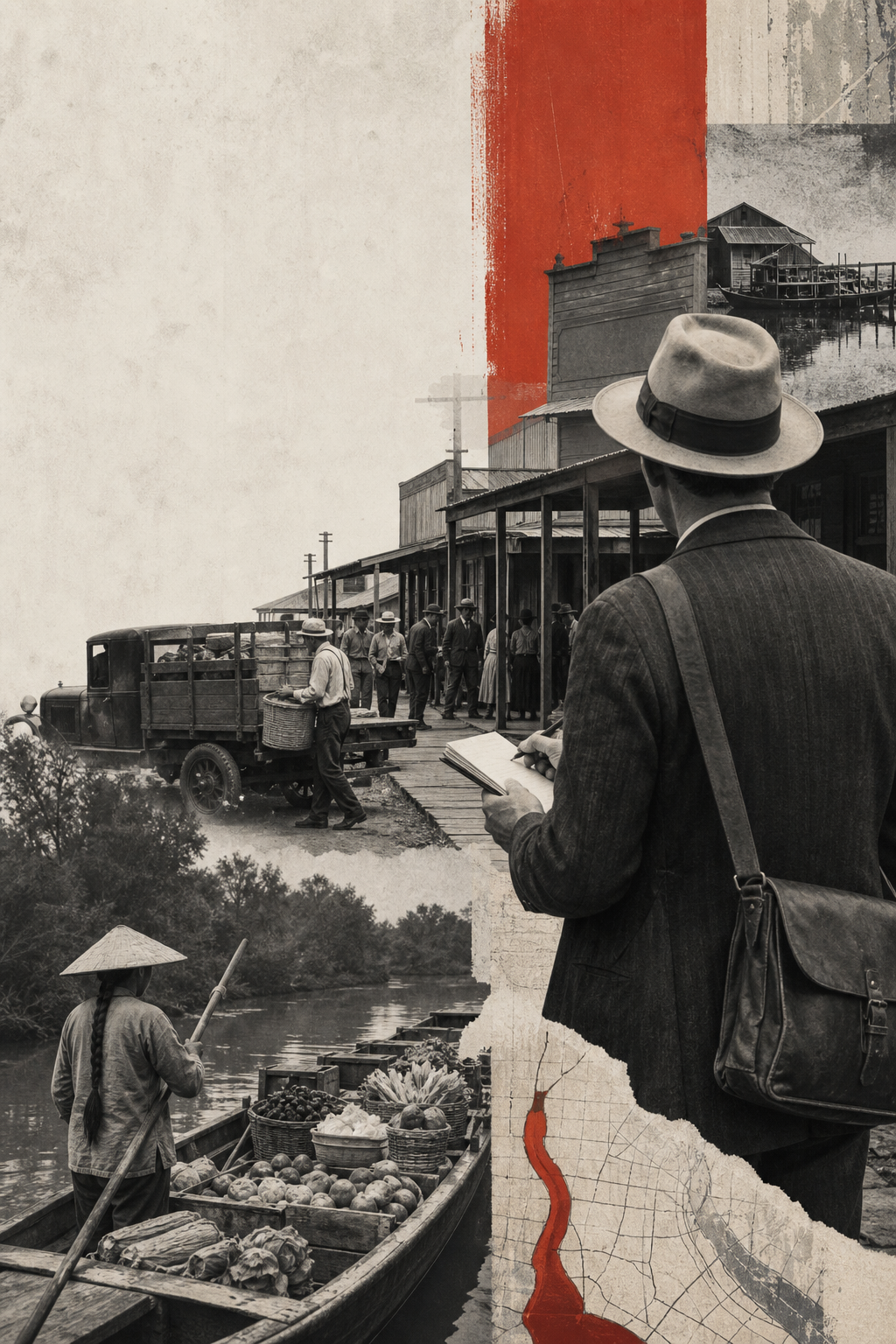
A truck rattled along the levee road toward the sheds. Beyond the buildings, the Sacramento River caught the low sun between trees and roofs. Men came down the road alone or in pairs, carrying dust from the fields and packing work with them. One had plant leaves stuck to his sleeves. Another carried his boots until he reached the shade of the covered walk.
The street had been quiet at midday because much of its work was elsewhere.
That was no longer something I had copied from Mei. I could see the proof in tired legs and empty stomachs.
Mrs. Chan stood in her doorway, watching two pots.
— You have the list? she asked.
I handed it to her.
She read it quickly. “Rice is right. Oil is right. Soap is late.”
— Mei said the shipment had not come.
— Then it has not come. She folded the paper. The account is in back. Bring it when you go.
Three men entered before I reached the counter.
— Food? one asked.
— If you sit down, yes.
They sat. Another customer came in with a child holding her hand. A woman bought a wrapped parcel to carry home. Someone asked whether Mr. Fong still repaired shoes after dark.
— Ask him, Mrs. Chan said. If he is awake, he repairs.
I found the account book near the kitchen door. It was heavier than it looked. When I brought it forward, Mrs. Chan pointed toward a rice sack in the doorway.
— Move that.
— To where?
— Somewhere it is not in my doorway.
I carried it to the back room.
When I returned, every table was taken. Mrs. Chan’s daughter brought bowls from the kitchen while Mrs. Chan moved from stove to counter to tables without stopping.
I had meant to collect the account and leave before the road grew dark. Instead, Mrs. Chan handed me a stack of bowls.
— Wash these.
— I should take this back to Mei.
— You should wash bowls first.
So I washed bowls.
Antonio Reyes appeared in the doorway with his cloth bag over one shoulder. He had not changed clothes since I saw him earlier. Dust marked his cuffs.
— The truck finally moved? I asked.
— For a while. He looked toward the kitchen. Mrs. Chan said she would have a parcel ready.
— For supper?
— For morning. Bread, vegetables, whatever she can spare. We start before the shops open.
Mrs. Chan set a paper-wrapped bundle on the counter.
— And soap, Antonio said.
— You will get soap from Mei, she told him. If she has any left.
Antonio nodded. “The contractor says another man may come tonight.”
— May, Mrs. Chan said. That word earns no one a bed.
— He knows.
Antonio did not sit down or ask for another meal. He had eaten earlier, before the packing shed called him back. Now he collected what he needed for morning and headed toward Yuen Chong Market.
He was part of the evening crowd, part of the market’s trade, and part of Sam’s Rooms’ business. But he was not the same as a permanent resident whose household was rooted in Locke. The distinction mattered. It did not make him less real.
Mrs. Chan caught me watching him leave.
— Blair.
— Yes?
— Those bowls have not washed themselves.
— They looked capable.
— Then hire them.
I returned to work.
When the rush eased, the sky had turned orange behind the roofs. I picked up the account book and headed toward the market.
The covered walks were full. People bought food and small supplies, stopped at the post office, spoke to repairmen, or greeted people coming in from work. A man asked about a room. Another asked about a shipment. Two women talked on a porch while a child leaned against one of them, half asleep.
The businesses stood close together, but the work that fed them spread across the Delta: fields, orchards, packing sheds, canneries, irrigation ditches, river landings, rail connections, and trucks carrying produce out.
A gust came over the levee road as I reached for my notebook.
It had been tucked under my arm. The wind caught its loose pages before I could close it.
One page struck a porch post. Another slid beneath a wagon. Two spun down the alley behind the market.
I ran after them.
A boy caught one against his chest before it reached a puddle.
— Your papers are escaping, he said.
— They have better sense than I do.
He studied the page. “What is fifteen hundred?”
— My bad answer to a good question.
He handed it back.
The page held my first estimate of Locke’s population. After seeing the busy morning street and hearing people ask about rooms, food, and work, I had turned everyone I saw into a resident.
Another page lay beside a stack of crates. I reached for it, but a wheel rolled over one corner. The paper tore beneath the wagon.
The surviving line read:
Main Street is where Locke works.
I stood holding the torn page.
Mei came out of the market with a small parcel.
— You are late, she said.
— My notebook objected to accuracy.
She looked at the scattered pages, then at the account book under my arm.
— Mrs. Chan’s account?
— Safe.
— Good. That is not yours to lose.
A man called to Mei from the market door. Another customer waited with coins in his hand. Antonio stood beneath the porch roof while Mei passed him soap from a shelf.
— The contractor’s man may come, Antonio told her.
— May? Mei said.
— That is what I said.
— If he comes, Kenji will decide whether there is a bed.
Antonio nodded and left for Sam’s Rooms.
Mei watched him go, then looked at my torn page.
— You have enough paper left to write a neat little story.
— I could.
— You could write that the street filled after work and call it finished.
My motorcycle stood beside the market. If I left soon, I could ride the levee road before dark. If I stayed, I would ride with an engine that had already needed persuasion that morning.
Mrs. Chan appeared in her doorway.
— Blair! If you are done chasing paper, I need help.
I held up the damaged page. “I need to write this properly.”
Mei’s face did not soften. “Not tonight. Tonight you either help, or you leave with the first thing you thought.”
The choice was clear.
I put the surviving pages into my jacket, gave Mei Mrs. Chan’s account, and returned to the restaurant.
The evening rush was worse than before. I carried bowls, rice sacks, and wrapped food. I fetched water. I moved when Mrs. Chan told me to move and stayed out of her doorway when she told me that too.
Outside, the Star Theater’s sign came on. Small groups drifted toward it after eating or shopping. Farther down the street, a gambling house admitted a few men. It was part of the district’s Prohibition-era trade, but it did not command the street. Most people were occupied with supper, rooms, parcels, repairs, messages, and the relief of seeing familiar faces after work.
By the time Mrs. Chan told me to stop hovering and sit down, night had settled over the roofs.
— You have missed your easy ride, she said.
— I noticed.
— Then you may as well eat.
At the market, Mei had cleared a place on the counter. My notebook lay there, its rescued pages pressed flat beneath a tin.
— You can write now, she said.
— I can write only what I can support.
— That would be new.
I opened the notebook. The first page was blank.
I did not rebuild the lost travel piece. It had been too pleased with its tidy shape. Instead, I wrote about workers returning from jobs beyond town; shops and restaurants serving needs that could not wait until morning; rooms, food, repairs, and messages passing along one narrow street.
Then I stopped.
— What number? Mei asked.
— Not tonight’s crowd.
— No.
— In later years, records would put Locke at about six hundred permanent residents in its busy decades. I tapped my pencil on the counter. But this evening does not prove that number. It proves only that a crowd can contain more than one kind of person.
— And your fifteen hundred?
— Crossed out.
The fuller picture came later. During growing and harvest seasons, and on busy weekends, roughly one thousand to fifteen hundred people might be present in and around Locke. That larger number could include seasonal workers, temporary boarders, and visitors. It was never a count of fifteen hundred permanent residents.
That night, I wrote no grand total.
Mei read my short page.
— You have left out half the town.
— I have left out what I do not know.
After a moment, she nodded.
— That is better than putting it in wrong.
It was not praise, exactly. From Mei, it was close enough.
My motorcycle started on the third attempt. I rode out along the levee road with the notebook inside my jacket and darkness ahead.
Behind me, Locke showed in pieces: a restaurant window, a market lamp, the theater sign, voices beneath a porch roof. Beyond those lights lay the river, roads, sheds, and fields that had sent people back to Main Street at day’s end.
The town still looked small from the road.
This time, I knew better than to make that mean simple.