Chapter 1
The Number in the Margin
By the time I reached Locke, my left leg had gone numb from the knee down.
The motorcycle had not broken anything important, but the ride from San Francisco had shaken every loose bone in my body. The levee road ran beside flat Delta fields and orchards. The Sacramento River appeared now and then beyond the trees, dull silver in the morning light.
I had planned to reach Sacramento before dark. A mechanic there had agreed to inspect the motorcycle at first light. I did not care to arrive after a long ride with another surprise from the engine.
For the moment, I wanted to stretch.
I stopped near town and killed the motor. As I worked feeling back into my leg, a man carrying a sack passed without more than a glance. Locke had work to do. My arrival did not belong to it.
I had heard of Locke as a Chinese American community in the Delta, where people tied to farm work could eat, sleep, buy supplies, and spend what they earned. I expected a few buildings and perhaps a store where I could ask for water.
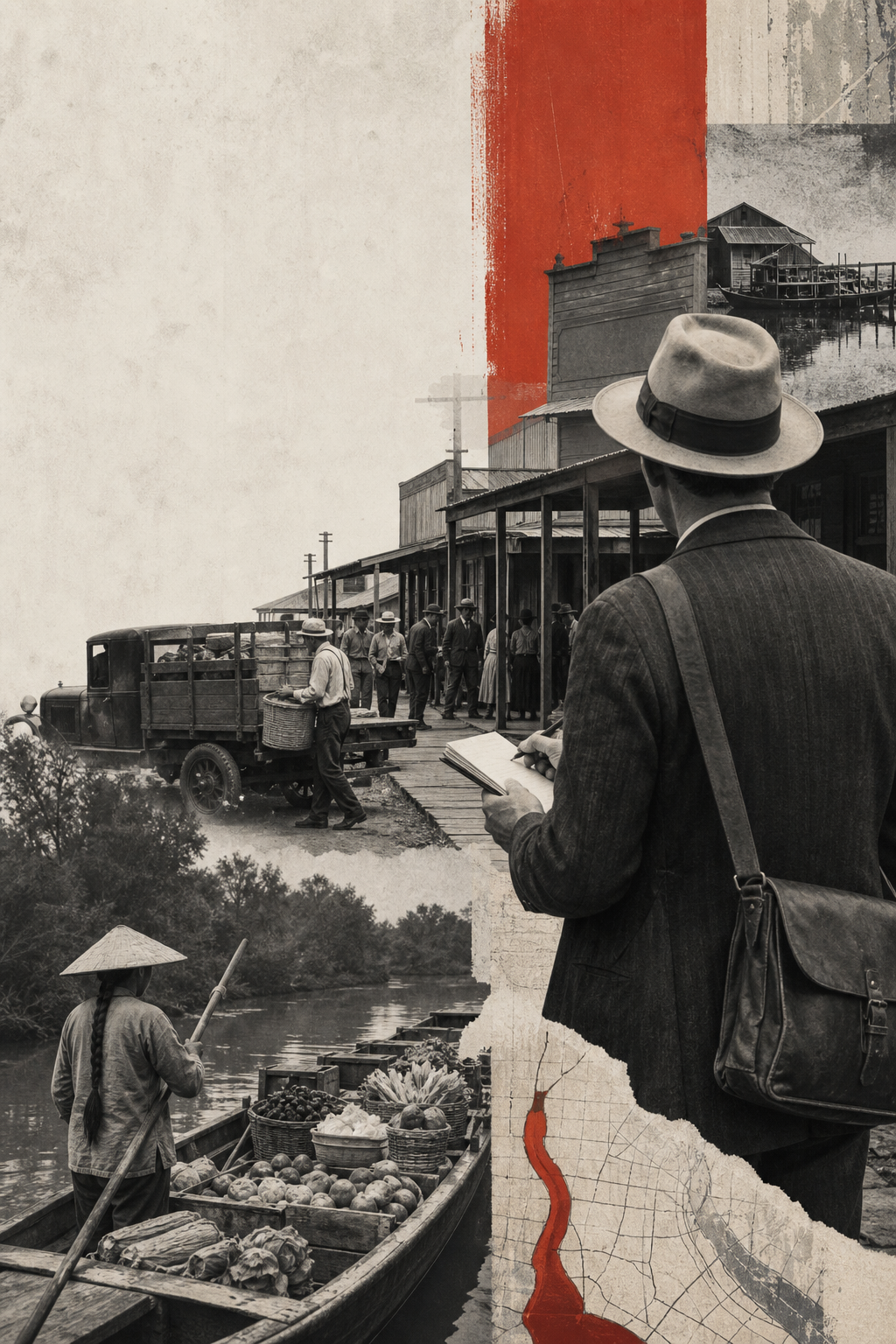
Instead, Main Street stood narrow and close behind the levee road. Wood-frame buildings lined it beneath covered walks and porches. Some had rooms above the shops. Others had back doors leading to sheds, gardens, and yards. Signs hung over the walkways. A child watched me from an upstairs window, then vanished.
The town was not large. It was busy.
I took out my notebook. I had kept travel notes for years, mostly for myself and sometimes for newspapers that paid late. My method was simple: observe quickly, write something lively, and leave before the place could contradict me.
I wrote:
Locke, California—small Chinese settlement on the levee. Population perhaps 1,200, judging by morning traffic. Main Street contains nearly all local activity.
— You counted them?
I turned. A woman stood beneath the sign for Yuen Chong Market, holding a pencil and folded paper. Her dark hair was pinned back, and her sleeves were rolled to the elbow. She looked at my notebook as if it had brought bad news.
— I estimated, I said.
— That is a polite word for guessing.
— I am a traveler. Guessing is one of our services.
— Then your service is poorly supplied.
I glanced at the page. “You object to the number?”
— I object to the confidence. One thousand two hundred what?
— People.
— People where?
I gestured along Main Street.
She looked down the street. Customers entered shops. Two women spoke in a doorway. Somewhere behind the buildings, a truck rattled over rough ground.
— Those people are here, she said. That does not mean they live here.
I closed the notebook. “How many live here, then?”
— About six hundred permanent residents in Locke’s busy decades.
— Six hundred? I looked again at the street. It feels larger.
— It can be. In growing and harvest seasons, and on busy weekends, perhaps one thousand to fifteen hundred people may be here. But that includes seasonal workers, temporary boarders, and visitors. It does not make them permanent residents.
She spoke with the patience of someone who had explained this before and disliked doing it again.
— So I was not entirely wrong.
— You were wrong in a useful way.
— I am glad to be of service.
Her mouth almost formed a smile. “And you are wrong about Main Street.”
— I have only just arrived.
— That has not stopped you from writing.
The market door stood open behind her. I smelled rice, dried goods, and something sweet.
— Come in if you need something, she said. Do not block the walk.
I followed because I needed water. Leaving would also have looked like retreat.
The market filled the front of the building. Shelves held sacks, tins, bottles, folded goods, and baskets of produce. A narrow passage led toward the rear. It was both shop and household space: goods in front, storage behind, rooms beyond the walls.
The woman set her papers beside the counter.
— Mei Lin, she said. I work here.
— Blair Fuller.
— From San Francisco?
— Yes.
— You came a long way to make a short mistake.
I bought water and bread. As Mei measured goods for another customer, I watched the morning pass through the market.
A man asked about a room. Another bought provisions and asked for directions to a packing shed. Someone came in for a repair item, though the market did not do repairs. Mei sent him farther down the street.
The questions came quickly: food, lodging, work, mail, a road, a price.
The signs and Chinese spoken between Mei and several customers made clear that Locke was rooted in Chinese American life. Yet the people through the door were not all alike. One customer asked after a Japanese American lodging keeper. Another asked directions in an accent I could not place. Mei answered each question without making a show of it.
I opened my notebook again.
Mei noticed. “You are counting?”
— Revising.
— That is better.
I crossed out population perhaps 1,200. The pencil tore the paper.
— How do you know the number is six hundred? I asked.
— It is the number used for permanent residents in Locke’s busy years. But numbers are not clean. Some accounts count residents. Others count workers, visitors, or people here for a season. You must say what you are counting.
I wrote: About 600 permanent residents.
Then: 1,000–1,500 people may be present in busy seasons and on weekends, including seasonal workers, boarders, and visitors.
Mei leaned over the counter. “Better. Still too neat.”
— Numbers are supposed to be neat.
— People are not.
A group of men passed the entrance carrying lunch tins. Their clothes were dusty. One stopped for tobacco. Another asked whether a room had opened at the boarding house.
— Are they residents? I asked.
— Some may be. Some may not.
— They are all going to work?
— Most likely. Fields, orchards, sheds, canneries, irrigation, transport. The work is outside this street.
I looked past them. Main Street had begun to empty. The buildings that seemed crowded minutes earlier now showed more closed doors than open ones.
— What happened to your twelve hundred? Mei asked.
— They went to work.
— Some of them did.
The distinction irritated me because it was fair.
The town was quieter, but not idle. Beyond the buildings came the groan of a truck and faint machinery. Shops prepared for later customers. Restaurants readied food. Lodging houses dealt with rooms. The farms and sheds took many workers for the day.
A market could be crowded at one hour and quiet at another. A restaurant might cook for people who had not returned. A boarding house could hold fourteen small upstairs rooms, while its boarders ate elsewhere because there was no dining room. A repair shop, post office, dry-goods store, dentist, theater, and other businesses could matter without all being busy at once.
I had wanted a picture. Locke offered a schedule.
At the motorcycle, I found a small dark puddle beneath it.
I crouched and touched the wet metal. Oil. Not much, but enough to make the engine’s next decision uncertain.
Mei came to the edge of the walk. “Can you fix it?”
— I can persuade it.
— Is that different?
— More expensive.
I checked the casing. A fitting had worked loose. The repair was small, but I had a long ride ahead and did not trust a machine that had announced itself twice that morning.
— Will it take long? Mei asked.
— An hour, perhaps.
— You still mean to reach Sacramento tonight?
— That was the plan.
— And tomorrow morning?
— A mechanic is expecting me.
— Then you should not waste daylight.
— That sounds like advice to leave.
— It is. Unless you mean to write about this town.
There was no warmth in the words, but no trap either.
I tightened the fitting and wiped my hands with the rag Mei offered. When I started the engine, it answered cleanly. For the moment.
— It runs, I said.
— For the moment, she said. You will not know more until you ride it.
Leaving would give me daylight and a better chance of reaching Sacramento on time. Staying meant riding later, with a doubtful fitting and a missed appointment if the road turned against me.
Mei pointed to parcels by the market door.
— If you want to understand Locke, she said, stop writing conclusions before the day is over. Take those to Sam’s Rooms. Kenji Kuramoto is expecting them. Come back afterward.
— You are hiring me?
— No. I am using the fact that you are still here.
— I could leave.
— You could. She picked up one parcel. Then write that you saw half a day and guessed the rest.
The engine ticked as it cooled.
I thought of the mechanic waiting in Sacramento, the cheap room I would need, and the empty road after sunset. Then I thought of my notebook, with its proud sentence already crossed through.
— When do workers come back? I asked.
— Later. If you stay long enough.
— That may cost me a night’s ride.
— It may.
I should have left. I had a route, an appointment, and a motorcycle that had earned no confidence.
Instead, I took the parcels.
— I will bring these, I said. Then I will come back.
Mei handed me the last one. “Do not lose them.”
— What are they?
— Food and supplies.
— For whom?
She gave me a level look.
— You are learning slowly, Mr. Fuller.
I put the notebook away. In its margin, three versions of Locke fought for room: a tiny settlement, a crowd, and a number that meant nothing until I named what it counted.
Beneath them, I wrote:
Find out where the day goes before deciding what the town is.
Then I followed Main Street toward the boarding house, carrying supplies for people I had not yet met and postponing the road I had meant to take.