Chapter 2
Where the Day Goes
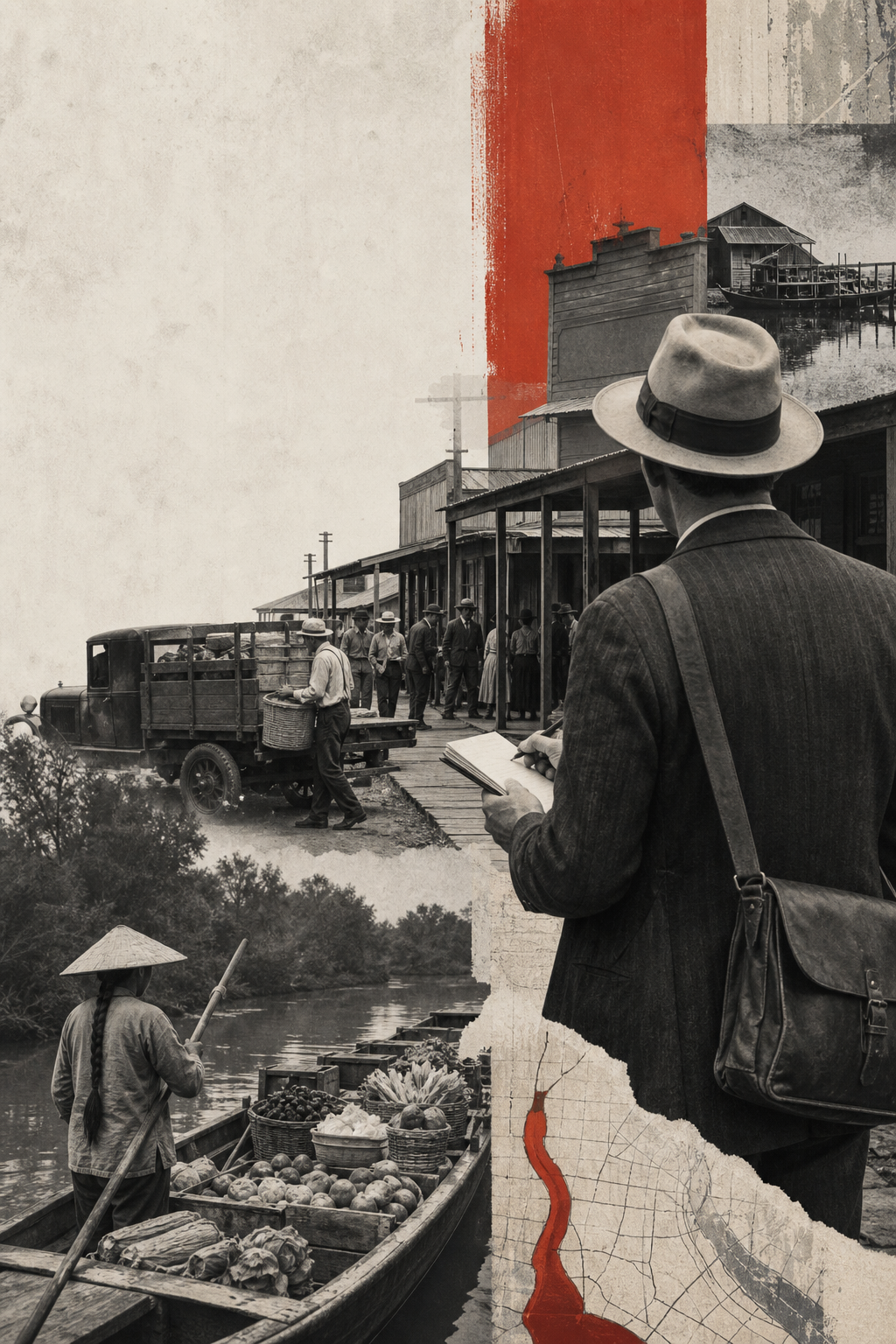
Sam’s Rooms stood along Main Street beneath a narrow porch roof. The front was painted wood, faded by weather. Behind it, an alley led toward sheds, small gardens, and storage yards.
I carried Mei’s parcels under one arm. She walked beside me with her market list folded in half.
— Use both hands, she said. The notebook can survive ten minutes without you.
— It has survived worse.
— That is not the same as being useful.
A young man came down the porch steps before we reached the door. He was lean, neat, and moving with the quick purpose of someone expecting supplies.
— Kenji, Mei called. Your delivery.
Kenji Kuramoto took the parcels from me and read the labels.
— Soap, rice, blankets, he said. Good. We may need the blankets tonight.
— More boarders? Mei asked.
— Maybe. One bed opened this morning. A man from the packing shed asked about another.
He looked at me. “You are Blair.”
— The visitor with the motorcycle.
— The visitor carrying parcels. Better than a visitor blocking the sidewalk.
Mei gave him a look that said he had been listening to her.
Inside, the ground floor held a desk, shelves, and a narrow hall. A ledger lay open beside a tin cash box. Kenji set the parcels down and checked the rice sack with one hand.
— The rooms are upstairs, he said. Fourteen small ones. That is all we have.
He did not offer a tour. He was already checking a line in his ledger, then another.
— There is a bed free? Mei asked.
— For today. Maybe tonight too. Depends on who comes in and whether they can pay.
A voice sounded from the doorway.
— The truck has not come back yet.
A man stood there with dust on his trousers and a cloth bag in his hand. He looked tired enough that standing still seemed like work.
— Antonio, Kenji said. You got away from the shed?
— Only until they call us again. He glanced toward the road. The loading is slow.
Antonio Reyes nodded at Mei, then at me. “You are the man who counts.”
— I am trying not to.
— Good.
Kenji checked the ledger again. “Your bed is paid through Saturday. What about the other worker?”
— He may come from Walnut Grove. The contractor said there could be more packing work if the shipment keeps moving.
— If he comes after dark, I cannot promise him anything.
Antonio rubbed his face with the back of his hand. “I need soap. And food before the truck returns.”
Kenji pointed toward the street. “Mrs. Chan can feed you. You know the way.”
Antonio started out. I saw his boots then. One strap on the left boot hung loose.
— Is that going to hold? I asked.
— It held this morning.
— That was not an answer.
— It is the answer I have.
Mei picked up the smaller parcel. “Take this to Mrs. Chan. She needs rice before evening. Blair can carry it.”
Antonio gave me a brief look. “Can you walk fast?”
— I have a motorcycle.
— That is not what I asked.
We left Kenji to his ledger.
Main Street was quiet in the early afternoon. A shoemaker bent over his bench near an open doorway. A woman swept a covered walk. A clerk crossed the street with a bundle against her chest. The shops were open, but the morning rush had gone. Most of the farm workers were still in fields, orchards, sheds, canneries, irrigation work, or transport jobs beyond town.
Antonio walked beside me, favoring his loose boot.
— The shed is near the river? I asked.
— Near enough to smell it when the wind turns. He adjusted the cloth bag in his hand. Today we sort and stack. When the trucks come, we load. When they do not come, we wait and hope the contractor does not decide there are too many men.
— You work there every day?
— Not every day. Not forever. He shrugged. This season, if there is work.
At the restaurant, steam blurred the front window. Mrs. Chan stood behind the counter with a ladle in one hand and a pencil tucked behind one ear.
— You are late, she told Antonio.
— The truck is later.
— That does not improve your stomach. Sit.
She saw the rice parcel in my arms. “Put that in the back. Not there. There.”
I carried it through a narrow passage behind the counter. The kitchen was hot. Shelves held bowls, jars, and sacks. Beyond the kitchen were rooms where the household lived. The building was a restaurant from the street and a family’s working home behind it.
Mrs. Chan filled a bowl for Antonio.
— You have twenty minutes, she said.
— I have had shorter meals.
— That is not something to brag about.
I stood uncertainly near the counter.
— Wash bowls, she said.
— I was carrying rice.
— You have finished carrying rice.
I washed bowls.
Antonio ate quickly. Halfway through the meal, he bent to inspect his left boot. The strap had split farther from the leather.
— It caught on a crate, he said.
Mrs. Chan looked down at it. “Mr. Fong.”
— He may have a line.
— He always has a line.
— The truck could come any time.
She turned to me. “Take the boot. Tell him it belongs to a man who may be called back to the packing shed.”
— I have never carried a customer’s boot through town.
— Then do not admire it. Deliver it.
Antonio pulled off the boot and handed it to me. His sock was gray with dust.
— If I go back with this loose, he said, it will catch again.
— And then?
— Then they use somebody else.
That was enough explanation. I took the boot and went.
Mr. Fong sat at a low bench inside his repair shop. Two pairs of shoes waited beside him. He examined Antonio’s boot, pressed the torn leather between his fingers, and gave a small grunt.
— Bad strap, he said.
— Can you fix it?
— Yes.
— The packing shed may call him back soon.
Mr. Fong looked toward the street. “Ten minutes.”
— You can do it that fast?
— I said ten minutes. Go.
When I returned, Antonio had finished eating. Mrs. Chan had wrapped bread and vegetables in paper for him.
— For later, she said.
— I can pay.
— You can pay when you have work next week. Eat first.
A girl came in through the back door with a school satchel. She set it down, washed her hands, and began sorting beans at the end of the counter.
— Finished at Walnut Grove? Mrs. Chan asked.
— Yes.
— Then finish those. Your Chinese lesson starts soon.
The girl made a face.
Mrs. Chan pointed her ladle at her. “The public school is in Walnut Grove, and it is segregated. You have already traveled there and back. Do not make me carry you to your Chinese and calligraphy lesson too.”
— I can walk, the girl said.
— Then walk after the beans.
The girl sorted faster.
I brought Antonio’s repaired boot back from Mr. Fong. He pulled it on, stamped once, and nodded.
— Good.
A truck horn sounded somewhere beyond the buildings.
Antonio stood at once.
— That is mine.
He took the food parcel, paid Mrs. Chan what he could, and headed for the street.
— Tell Kenji about the other worker, Mrs. Chan called after him.
— I will.
In a few minutes he would be back at the packing shed. His work would happen away from Main Street, but his bed, meal, soap, and repaired boot had all come from this short stretch of town.
Mrs. Chan turned to me. “Take this to Mei.”
She handed me a note.
— Rice? I asked.
— Rice, oil, and two things I am already low on. Tell her I need the account from yesterday brought back before supper. I cannot keep guessing what I owe.
At Yuen Chong Market, Mei read the note while checking shelves.
— Of course, she said. Everyone needs rice before evening.
— You knew that?
— I know Mrs. Chan cooks for people who do not cook where they sleep. Kenji sends boarders to her. Antonio needs food before the shed calls him back. It is not magic.
— I did not say it was.
— You looked as though you had discovered a new river.
She gathered several items from the shelves, then stopped at the account book.
Behind her, a customer asked for dry goods. Another wanted directions to the post office. A man on the porch asked whether Mr. Fong could repair a coat as well as shoes. Mei answered each question while adding figures in the book.
I watched her work. The market was not only a place to buy goods. It connected people who needed rooms, food, repairs, mail, and directions.
— You own this building? I asked.
— My family owns the building.
— That sounds safer than renting.
Mei stopped writing.
— It is safer than having no building, she said. That is not the same thing.
I waited.
— We lease the ground. Many people here can own what they build but not the land under it. The law has made land ownership harder for Chinese immigrants.
— The Alien Land Law.
— Yes. And exclusion laws have kept families apart for years. A shop does not remove those rules.
Her voice was even, but she pressed the pencil hard enough to mark the page beneath the one she was writing on.
I thought of the sentence in my notebook about prosperous shops. I found it and read it again.
Prosperous shops show secure lives.
It had seemed clever in the morning. Now it sounded lazy.
I crossed out secure.
Mei went back to her figures.
— Not everyone here works in the fields, she said. You have met a lodging manager, a cook, a repairman, clerks, and a packing-shed worker. There are merchants, contractors, tenants, growers, and people who move produce. There are families. There are children with school and chores.
— And field workers.
— Yes. Many people depend on the farms. That does not make them all the same.
I wrote a plain note beneath the ruined sentence:
Main Street businesses could support a household, but leases and unfair laws still limited what people could keep or pass on.
Mei glanced at it.
— That is closer.
She packed Mrs. Chan’s order into two parcels and tied them with string.
— Take these back. Bring her account from yesterday.
— You trust me with accounts now?
— I trust you to worry about losing them.
— That is nearly praise.
— It is not.
I took the parcels. Outside, Main Street remained quiet, but it was not empty. A room waited at Sam’s Rooms. Rice waited in Mrs. Chan’s kitchen. Mr. Fong’s repaired boot was back at the packing shed. Mail, repairs, food, and rent moved from hand to hand.
By evening, the workers would return and the street would look crowded again.
For now, I understood why.