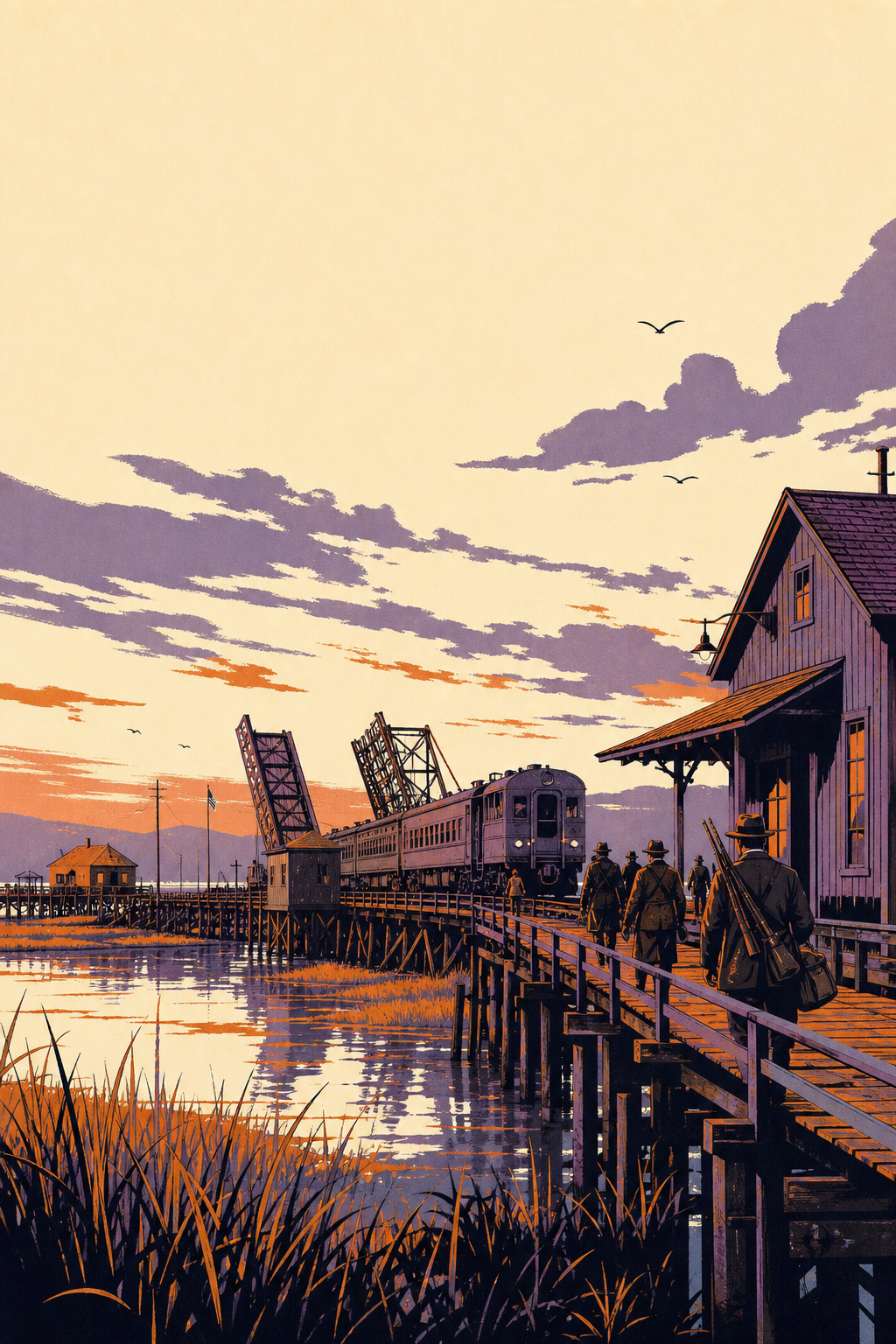
Chapter 3
After the Whistle
Morning brought rain against the hotel windows and wind that pushed marsh water higher beneath the boards.
Rosa woke before most of the guests. In the kitchen, Celia tied her hair under a cloth while the wood stove found its heat. Damp coats hung from chair backs. Plates waited beside two shallow basins. Outside, a bucket knocked against the water barrel.
— How long have you been up? Rosa asked.
— Long enough to dislike every man who slept past dawn.
— That is a useful beginning.
— The gentleman in room four wants hot water.
— He can want it quietly.
Rosa checked the barrel. The weekend crowd had drawn it down too far. Water had to be carried, stored, and watched. A visitor could empty a basin without seeing the extra trips it gave someone else.
Hunters came back from the northern cabins before breakfast, wet through at the cuffs and muddy to the knee. Some talked about birds and weather. Others had the look of men who had expected the marsh to behave like a park and had been corrected before daylight.
The Marsh House filled again. Beds were stripped. Towels were gathered. A man searched beneath the dining table for a sock and declared that he had never taken it off.
Then a woman from one of the south houses appeared at the kitchen door with a covered water container under her arm.
— This was behind your pantry, she said.
Rosa knew it at once. It did not belong to the hotel.
— A guest must have brought it in with the dishes, Rosa said.
— My children went looking for it.
— I’m sorry. I thought it was ours.
The woman’s mouth tightened. “You thought wrong.”
The dining room quieted. Rosa felt the old pull between welcome and duty. The hotel needed paying guests. The households around it needed to know that a busy weekend would not swallow their things.
She took the container and handed it back. “We’ll mark ours before noon.”
The woman gave one hard nod and left.
Celia came in from the porch with a folded coat over one arm. “Anna is asking about the train.”
— Tell her Michael will say when the station side is clear.
— She does not enjoy waiting.
— Neither does the tide.
Near the station, Edwin Hale stood beside a neat stack of cases while his companions packed for their return. The main catwalk was clear. No one had left bundles across Paolo’s work route. Edwin had learned that much, though Rosa did not intend to congratulate him for it.
Michael came from the station office with rain shining on his cap brim.
— Keep the approach open, he said. Passenger service will be through before long.
Edwin nodded. “It will be.”
A man from his cabin party called, “Hale, if we miss this one, we sit half the day.”
Edwin lifted a hand without looking back.
By late morning Paolo had not returned from the lower platform, and the provisions expected by water had not come up. Rosa counted what remained: flour, coffee, onions, a little meat, and bread enough for a smaller meal than the guests would like.
She did not announce the shortage. She cut the bread thinner.
Celia watched her. “Will there be enough?”
— For the people we are feeding.
— And for me?
— For you too.
Celia gave a doubtful smile. Her next job waited beyond Station Island. If she missed a useful connection, Rosa’s recommendation would not fill her pocket.
— You said I would get there, Celia said.
— I said I would try.
— That is a colder promise.
— It is the honest kind.
The rain eased after noon. The water did not.
Paolo came through the back door wet to the knees, a coil of line over one shoulder. His face had the tight look Rosa knew from men who had been measuring tide against time.
— The supply boat made the channel, he said. It cannot stay.
Rosa set down her knife. “What has it?”
— Flour. Potatoes. Lamp oil. Enough to get you through the rest of this crowd. He looked toward the dining room. If we move it now.
— Can you bring it up?
— Not all of it. Current’s pushing the boat off the landing.
There was no town crew to send down. No office where someone might telephone for a pair of hands. Drawbridge had a station telephone, but a telephone could not hold a wet rope or carry a sack up slick boards. The people nearest the work were the help there was.
Edwin came in from the porch, hat in hand.
— My companions are ready, he said. We need to go down.
Paolo glanced at him and said nothing.
Rosa did not ask Edwin to stay. She had spent the weekend refusing to treat his money and familiarity as a claim on everything around him. If he wanted the train with his companions, he could take it.
Then a shout came from the landing.
Paolo turned for the door. Rosa caught up her skirt and followed. The lower boards were slick, and water slapped hard against the pilings. Below the platform, a small working boat rocked against its line. Sacks and crates lay beneath a canvas sheet.
Paolo seized the rope, tested it, and swore.
— The pull’s wrong, he said. I need somebody to keep her off the posts while I pass things up.
— I’ll take it, Rosa said.
— You need to get Celia and Anna to the station.
Rosa looked back toward the hotel. Celia stood in the doorway with her coat over one arm. Anna waited beside her with a small bag. Beyond them, Edwin’s companions had gathered by the station path.
— Edwin! one called. Now.
Edwin looked from the waiting men to the boat. His face showed the thought before he spoke it: there ought to be someone else. Someone whose job this was.
The boat swung outward and struck a piling.
Paolo hauled at the rope. “Decide.”
Rosa said nothing.
Edwin put his hat down on a dry patch of boards. “Where do you want me?”
Paolo looked at him once. “Here. Keep it clear of the posts. Don’t wrap it around your hand.”
Edwin took the line.
The first pull nearly dragged him forward. He planted his boots, leaned back, and held. Paolo lifted a sack from the boat to Rosa. She dragged it onto the platform, her palms burning against wet canvas.
— Flour first, Paolo said.
Another sack came up. Then potatoes. Two cans of lamp oil wrapped in cloth.
The whistle sounded across the marsh.
Edwin’s head turned toward the station. His companions were visible through the rain, waiting beside their cases. One of them called his name again, sharper now.
The boat swung toward the piling.
— Line! Paolo shouted.
Edwin turned back. The rope slid in his wet glove. He caught it, braced himself harder, and pulled until the boat held clear.
Paolo passed up the last crate. Rosa hauled it beside the others. The train clattered into the station beyond the hotel. Doors opened. Voices rose. Luggage scraped over boards.
Edwin’s companions disappeared toward the cars.
He stood bent over the rail, breathing hard.
— You missed it, Rosa said.
He nodded once.
For a moment she expected him to blame Paolo, the tide, the train, or her. Instead he looked toward Celia and Anna.
— Get them on, he said.
Rosa did not thank him. There was no time, and thanks would have made the work sound finished.
Paolo carried flour toward the hotel. Edwin took the other end of the sack without being told. Rosa led Celia and Anna along the safer boards to the station, where Michael kept passengers moving with blunt gestures and no patience for questions.
Anna boarded first. Celia followed, then turned from the step.
Rosa held out a folded note.
Celia read it. “Reliable. Quick. Keeps her head in a rush.”
— It is true.
— You left out the worst parts.
— Employers dislike honesty.
Celia gave a tired laugh. “That is what I was afraid of.”
She tucked the note inside her coat. The train took her away toward another uncertain job, and Anna with her toward work beyond Drawbridge.
When the cars had passed, the station side looked larger. The hotel still held wet bedding, dirty dishes, and hungry people. Paolo still had work delayed by the tide. But flour stood dry in the kitchen, potatoes waited in a sack by the stove, and the lamp oil had not gone into the water.
A crowded weekend could make Drawbridge seem larger than it was. No one on the boards that afternoon was taking a formal count. Rosa saw only who had gone, who remained, and what still required hands.
At dusk, kerosene lamps showed in the raised houses. Rosa carried a pail along the southern boards. Michael walked beside her, quiet after his day at the station.
— Anna made it, he said.
— And Celia.
— Good.
North of the station, Edwin waited with one case and his damp coat. He would leave on a later passenger service, alone rather than with the cabin party he had hoped to impress.
— He held the line, Michael said.
— He did.
— That does not make him local.
— No. Rosa shifted the pail in her hand. It makes him late.
Michael’s mouth moved, almost a smile.
Beyond the boards, water moved through the marsh, black beneath the evening sky. Another day, the railroad would bring commuters, workers, hunters, guests, and supplies. It made Drawbridge possible. It did not make it easy.
Rosa went back toward the hotel. There were lamps to fill, food to put away, and water to watch.
When the later whistle came, Edwin would go.
The work would remain.