Chapter 2
The Marsh Belongs to the Tide
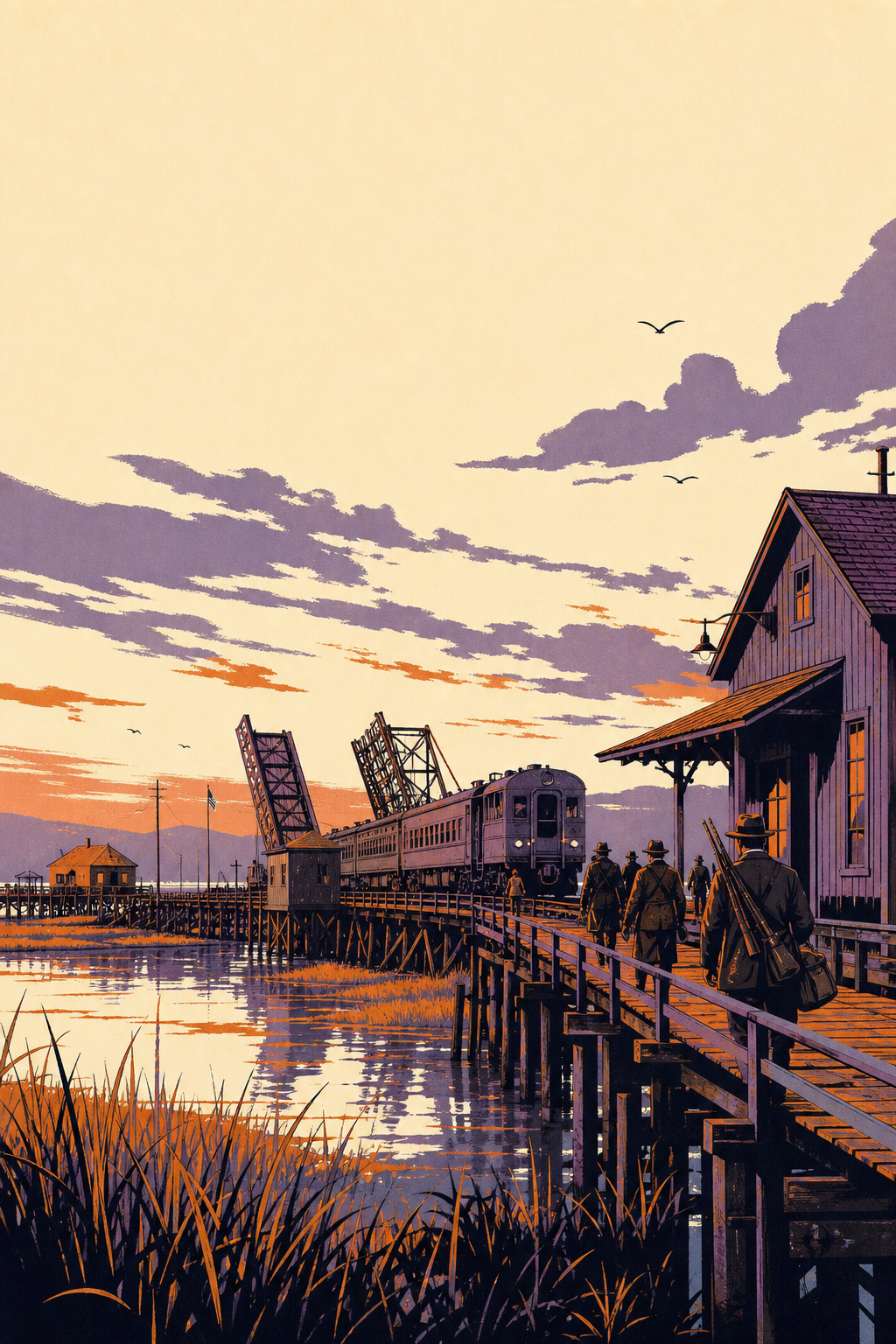
The train crossed the bridge toward Alviso, its sound thinning over the water.
Drawbridge did not grow quiet. It divided into smaller crowds. Men stood by the station with cases at their feet. Hunters asked which walk led north. Hotel guests filled the Marsh House porch and looked from the wet boards to the gray marsh as if someone had misplaced the rest of the town.
Inside, Celia had names and room numbers spread beside the kerosene lamp.
— Four need beds, she said. Two say they only want breakfast. The man with the cough says he reserved room five.
— He has room five.
— He says it smells damp.
Rosa took the paper from her. “It is damp.”
Celia waited.
— That is all the answer he gets.
The hotel had narrow rooms, a dining room, a kitchen, and a porch facing the tracks. It also had one stove, a small staff, and water that had to be carried and watched. Rosa moved through the rooms with a cloth over one shoulder, checking blankets and empty basins. She could hear questions gathering downstairs.
Edwin Hale stood near the dining-room door, hat still on.
— My companions are waiting at the cabin, he said.
— So are other people waiting for rooms.
— They expected me this morning.
— They expected a train, too. The train brought half the Bay with it.
He looked toward the station. His luggage was still piled under the porch eave, where Rosa had told him to leave it.
— I have been coming here for years.
Rosa folded a blanket and set it on a chair. “Then you know the boards are wet.”
— That is not what I mean.
— I know.
For a moment he said nothing. His good coat was no longer quite so good. Damp had darkened the hem, and mud had marked one boot.
The back door opened. Paolo Ferri stepped inside, bringing cold air and the smell of rope. Mud covered the lower part of his trousers. He carried a coiled line over one arm and a sack in the other hand.
— The water’s coming up, he said. I need the lower platform while I can use it.
Paolo worked around the oyster beds and shrimp grounds when the tide allowed. Some days he handled catches. Some days he moved supplies or helped with boats. The work changed with the marsh, but it did not stop because visitors wanted a clear way to their cabins.
Edwin glanced at the sack. “Could you take a case north when you finish?”
Paolo looked at him, then at the case waiting by the station.
— I’m going south.
— It was only a question.
— And that’s the answer.
Paolo set the sack by the kitchen wall and left again.
Celia picked up a stack of towels. “The gentleman in room six says he paid for a view.”
— He has one.
— Of what?
Rosa looked through the window. Mud, water, raised roofs, and a strip of rail disappeared into fog.
— Of Drawbridge.
Celia nodded as if she had expected nothing better and carried the towels upstairs.
A shout rose outside.
Rosa went onto the porch. Near the station, two men from Edwin’s cabin party had turned toward the rail-side crossing by the bridge approach. They carried bags between them and were heading for a line of boards that led toward Paolo’s work landing.
Michael Duffy came out of the station office.
— Not there, he called.
One of the men waved. “We know the way.”
— You don’t.
Michael pointed toward the longer catwalk. “Use that.”
The man nearest the water stepped onto the first board anyway. It shifted under his weight. His foot slid. He caught his companion’s sleeve, and both men lurched sideways.
A warning sounded from the bridge.
Michael reached them fast. He caught the first man by the coat and dragged him back from the edge. The second man lost his bag in the mud.
The engine came through the fog with a hard clatter. Everyone stood still until it had crossed.
Michael used a hooked pole to pull the bag free. He handed it back without brushing off the mud.
— Long way, he said.
The men took the long way.
Edwin stood beside Rosa on the porch, looking toward the bridge.
— He could have said it differently.
Michael heard him. “Could have. Didn’t.”
Then he went back toward the station.
Rosa turned to Edwin. “Your cabin is north. That crossing is not.”
Edwin’s face had tightened. “No one was hurt.”
— Not this time.
A guest called from upstairs for another blanket. Someone in the dining room wanted coffee. Rosa started back inside, then saw Paolo waiting below the porch.
— Rosa, he said. Come look.
Edwin followed before she could tell him not to.
The three of them took the boards behind the hotel. Paolo walked first, quick and careful, keeping his weight near the posts. Rosa followed with a small lantern. Edwin came last, carrying one of his own cases now that he had seen what leaving it at the station might mean.
The walk bent toward the lower platform. Behind them, South Drawbridge held more of the houses where people stayed through the week. North of the station were more cabins and club buildings, at least according to the old talk. People attached other divisions to that map: Catholic families here, Protestant cabin men there; Italian, Irish, Portuguese, English. Rosa had heard it all her life.
The island was not that neat. Her mother traded gossip with women from north of the station. Michael had friends among men who used cabins. Paolo worked for whoever had need of him. Still, the direction of a person’s footsteps could tell Rosa a great deal. Some people walked toward a bed they owned for two days. Others walked toward work that could not wait.
At the junction near the platform, Paolo stopped.
A narrow stretch of boards ran toward the water. The tide was already pressing beneath it. One plank near the outer edge had lifted slightly from its support. It did not look dangerous until Paolo put his boot beside it and showed how it moved.
— That one, he said. Don’t step on the outside.
Edwin peered down. “Can it not be nailed?”
— It can, Paolo said. Later.
He pointed toward the platform. A bundle of gear lay there beside Paolo’s sack. “I need that moved under cover. If the water comes over, it stays wet.”
Edwin looked past the platform toward the cabins. “This is the direct way north.”
— Not today, Rosa said.
— My men have been waiting.
— So has Paolo.
Edwin shifted his case from one hand to the other. “The longer walk will take twice as long.”
Paolo began to lift the sack.
Rosa took the lantern from her belt and held it out to Edwin. “Then carry this.”
He stared at her.
— You wanted to see why we are not sending people this way.
He took the lantern.
Paolo stepped onto the safe side of the boards, carrying the sack. Rosa followed. Edwin came behind her. The catwalk seemed narrower once he had a light to protect. Wind pushed at the flame through the lantern glass. The tide slapped softly against the pilings.
At the loose board, Paolo crossed without looking down. Rosa stepped over the firm inner edge.
Edwin placed his boot too far out.
The board dropped under him.
He caught the rail with one hand. The lantern swung hard. For a second he held himself still, one shoulder twisted, the case pulling at his other arm.
Paolo set down the sack and reached back. He did not grab Edwin. He only said, “Put the case down.”
Edwin did. The case landed with a thud on the safer boards.
— Now your foot, Paolo said.
Edwin moved it inward and steadied himself.
No one spoke until they reached the platform.
Rosa watched him breathe through his nose, annoyed at being frightened in front of them.
Paolo gathered the bundle and tied it beneath an overhang. He worked quickly. Water was reaching the first step below the platform.
Edwin looked toward the northern cabins again. The line of buildings seemed close across the marsh. From where he stood, he could see the longer catwalk running back toward the hotel and around the safer side of the island.
— My companions cannot come through here, he said.
— No, Rosa said.
He looked at her, waiting for an argument.
— There is room on the long walk, she added. Tell them to use it. Carry what they need. Leave the rest until they can move it without blocking somebody else.
Edwin’s mouth opened, then shut.
Paolo lifted his sack again. “I have to go.”
Rosa stepped aside.
On the return walk, Edwin carried his own case more carefully. At the junction, he stopped and looked down at the loose board.
— You knew it would give, he said.
— I knew it might.
— That is not much comfort.
— It is enough to choose another way.
He gave a short laugh that had no amusement in it. “You make it sound simple.”
— It is simple. Not easy.
Back at the hotel, Edwin found his companions near the station. Rosa did not follow him, but she heard his voice carry across the boards.
— Long catwalk, he said. Not the bridge side.
One man protested. Edwin answered more sharply than Rosa had expected.
— Take the long way.
The cabin men began gathering their bags.
Inside, Celia was rinsing cups in a shallow basin. She had found the missing guest at one of the northern cabins and brought him back with one muddy shoe and an expression of injured innocence.
— He says no one told him the boards ended, she said.
— Did they?
— He says they did. He just thought they meant somebody else’s boards.
Rosa took the basin from her before it spilled. “Did he ask you to carry anything?”
— A bottle. A note. Then his coat.
— And?
— I said I was working.
Rosa looked at her. Celia’s hair had come loose around her face, and the cuffs of her sleeves were wet.
— Good, Rosa said. You are.
By evening, the Marsh House smelled of wet wool, cooked food, smoke, and kerosene. Cards slapped near the porch. A few guests drank from cups by the window. Somewhere farther south, music carried briefly when the wind turned.
Visitors told stories about Drawbridge as if it had no rules at all—gambling, drink, bootleg liquor, worse things hinted at with pleased voices. Rosa had heard such stories before. There were quarrels here, drinking too, and some hotels had louder nights than others. But the stories never mentioned the people filling lamps, mending boards, cooking meals, or working the tide.
Edwin came in late, his boots muddy to the ankle. He moved aside when Celia passed with a pot of stew.
— Thank you, she said, surprised enough to make the words sound plain.
He nodded and took a seat near the wall.
Rosa stood at the back door with an empty pail in her hand. Paolo’s tools rested under cover. Beyond the hotel, water moved beneath the boards, dark and steady.
The tide had not changed its mind for anyone. It had only made clear whose work had to be done first.