Chapter 1
Before the First Train
Before dawn, Rosa Valente carried the first water of the day across the boards behind the Marsh House Hotel.
She did not fill the buckets to the rim. A full bucket was trouble enough on firm ground. On the narrow walk, slick with fog, it could pull a person sideways or slosh over the lid. Below, tide water moved among the pilings.
The hotel stood near the station, raised above the marsh like the other buildings around it. Its porch faced the tracks. Inside were narrow rooms, a kitchen, and a dining room that could seem almost respectable until a hunting-season train arrived.
Rosa entered through the back door with her shoulders already aching.
Celia Barnes knelt by the wood stove, feeding kindling into a weak flame. She had come from San Jose the day before with a small case, a reference, and shoes that had not yet learned the boards.
— Dry wood is under the table, Rosa said.
— I found it.
— Then make it last.
Celia looked at the thin flame. “I have never known a place where less wood was meant to make more fire.”
— You are learning Drawbridge.
Rosa set the buckets beside the covered water barrels. One was for cooking, one for washing, and one for whatever emergency a paying guest could create before breakfast. Guests noticed a clean basin. Rosa noticed how far each bucket had to travel before it became one.
She touched the folded note in her apron pocket.
Her niece Anna was due on the morning train. Anna worked outside Drawbridge and had agreed to carry Rosa’s note to a hotel manager in San Jose. The manager might need kitchen help by spring. It was not an offer. It was only a question, written after midnight in Rosa’s careful hand.
Still, it was Rosa’s question.
If an answer came, there might be steady pay somewhere beyond the Marsh House. A larger kitchen. A room where a day off did not disappear into hauling water and meeting other people’s demands.
She had told no one but Anna.
— Rooms first, Rosa said. Then laundry. If anyone asks for something, bring the request to me.
— What if it is urgent?
— Most things become urgent after someone has paid for a bed.
Celia stood and brushed ash from her skirt.
Rosa checked the rooms, straightened blankets, and trimmed the wicks in the kerosene lamps. There was no electric light in Drawbridge yet. A bad wick could leave a guest stumbling in the dark, and a careless lamp could make worse trouble than a complaint.
Outside, the settlement was waking.
A man with a lunch pail left a house near the rail bed. At the lower platform, someone checked a rope on a work boat before the water changed. A woman called a child back from the station path. The child came reluctantly.
Rosa took a basket of empty tins and led Celia toward the station.
— Third plank past my mother’s house dips, she said. Step near the nail head.
Celia looked down. “You remember every bad board?”
— The bad ones remember you if you don’t.
They passed raised houses, sheds, small cabins, and walks that bent around mud and water. Drawbridge had enough roofs for a visitor to call it a town. Rosa never did. It had no proper streets, only boards, catwalks, the rail bed, and the sloughs. When something went wrong, there was no office to summon help from. Someone who knew the route came with a hammer, a rope, or a bucket.
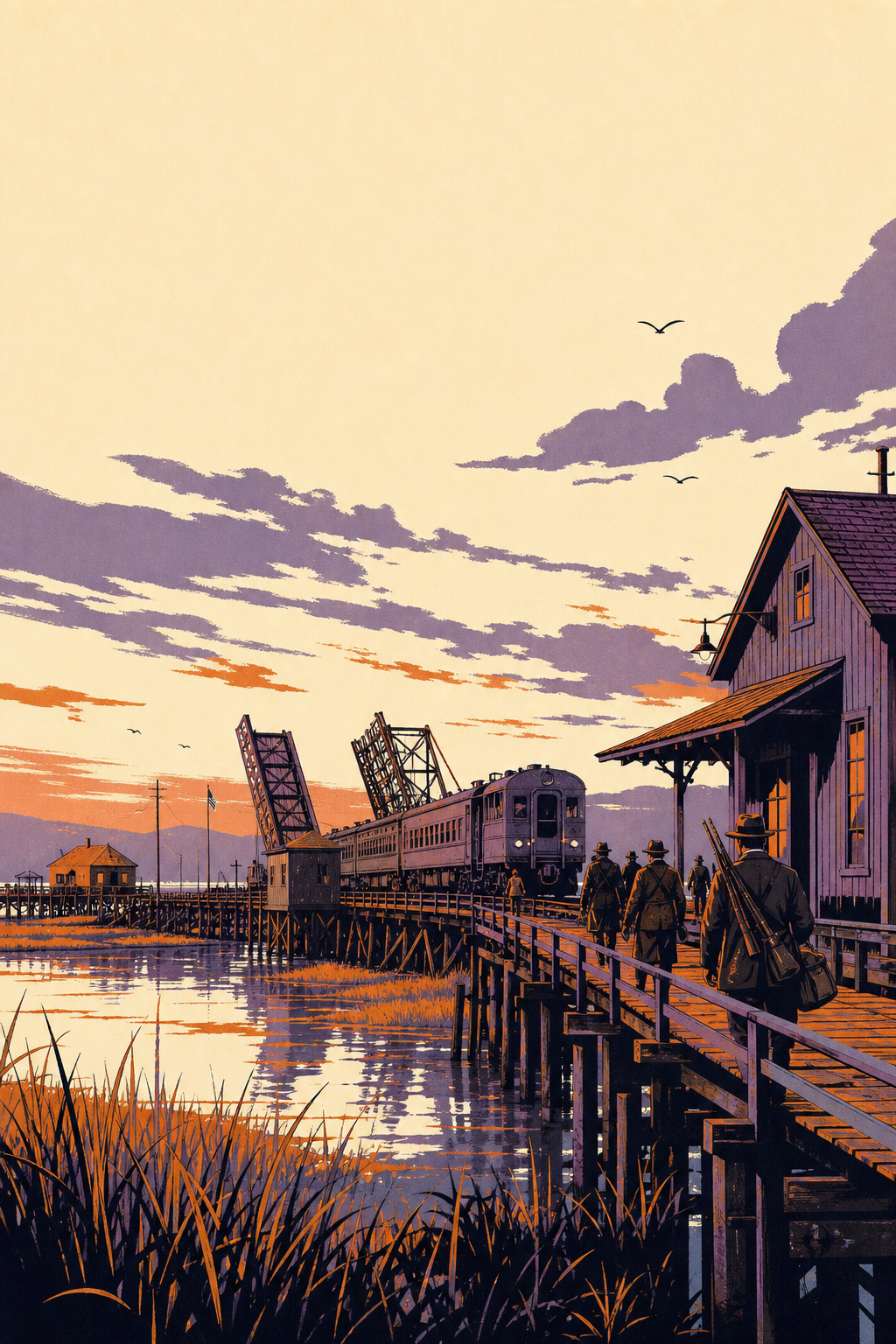
The railroad had made the place possible. The bridges over Coyote Creek and Mud Slough had brought the first bridge workers, then families, hotels, cabins, and all the people who came and went by train. But the marsh had its own traffic. Work boats used the water, as larger craft had done before them, carrying the valley’s goods toward San Francisco. The same channels carried fishers, shrimpers, oyster workers, hunters, and anyone foolish enough to believe mud was only mud.
Rosa had grown up hearing older people call it empty marsh before the rails. Her mother disliked that phrase.
Empty to whom? she would say.
The land lay within an older Ohlone and Miwok homeland. The railroad had changed it; it had not made it begin.
At the station, Michael Duffy stood near the bridge approach. He watched the track, then the water, then the track again. His cap covered his ears. His patience covered less.
— Anna is coming? Rosa asked.
— She had better be, Michael said. The train won’t wait because she has a clever aunt.
— She is not late.
— Then you are both disappointed.
A telephone rang inside the station office. Michael went in to answer it. Rosa watched Celia studying the platform, the track, and the mist beyond the bridge.
— You stay off the rail unless Michael tells you otherwise, Rosa said.
— I was not planning to walk in front of a train.
— Visitors say that too. Until they see a shortcut.
Michael returned.
— Train’s on, he said.
Anna came through the fog a moment later, coat buttoned to her throat and papers tucked beneath one arm. She looked tired, as she often did before a workday outside Drawbridge.
— You have eaten? Rosa asked.
Anna gave the answer Rosa expected: a glance away.
Rosa handed her bread wrapped in cloth. “Take this.”
Anna nodded toward the sound approaching over the water. “I cannot wait long.”
— I know.
The whistle came across the marsh.
Celia stepped beside Rosa, holding the basket against her skirt. The train appeared through the fog, dark cars bright at the windows. It slowed at the station, and the quiet morning broke apart.
People stepped down with luggage, wrapped provisions, and hunting gear. Some wore practical coats already marked by travel. Others had clean collars, city shoes, and the careful look of people who expected the place to be rough but not inconvenient.
Hunters headed for cabins and clubs. Hotel guests asked for rooms. A pair of men wanted a boat. Others had come only to see the marsh or spend a day away from the city.
The platform filled faster than Rosa had expected.
A woman asked where to leave a valise. A man wanted breakfast at once. Someone called from the porch about a missing blanket.
— Porch first, Rosa told Celia. Room people on the left. Meals only by the door.
Celia began taking names on scraps of paper.
Then Rosa saw Anna moving toward the train steps.
— Anna—
A man crossed in front of Rosa with two bags. Behind him, a guest called for her. Celia turned, waiting for instruction.
Rosa reached into her apron pocket.
The note was gone.
For one sharp second, she thought it had slipped onto the wet boards. Then Anna lifted it from beside the bread.
— I have it, Anna said.
The conductor called.
Rosa wanted to tell her not to soften the words. To make the manager read them. To say that asking about work elsewhere did not mean Rosa meant to leave tomorrow, or stop loving her mother, or forget this difficult place.
But another guest was demanding food, and Celia had three names in one hand and no answer for any of them.
— Go, Rosa called.
Anna boarded.
Edwin Hale stepped down near the end of the crowd.
He was neat without being delicate, in a good coat and boots still clean from the city. A leather case hung from one hand. More luggage waited behind him on the platform.
— Miss Valente, he said.
Rosa knew him. He came during hunting season and shared a North Drawbridge cabin with men who had money, leisure, and opinions about the marsh. He knew several residents by name. He had eaten at the hotel and once helped carry a broken oar.
He treated that as membership.
— Mr. Hale.
— I need someone to take these north.
— So does everyone else.
— I have a standing arrangement.
— You have a cabin arrangement. I have six people standing on my porch.
His smile tightened. He looked past her at Celia, who was carrying blankets toward the hotel.
— Your new girl can take the bags.
Celia stopped.
Rosa looked at him. “She works for the hotel.”
— I am paying for help.
— You are paying for a room and a meal.
— And I have paid here before.
— Yes, Rosa said. That is why I remember you.
Beyond him, two visitors started along the track toward the bridge approach. Michael raised an arm and called them back. They laughed as if he had made a joke.
Michael did not laugh.
Edwin lowered his voice. “I only need a small favor.”
— And Celia only has two hands.
The train gave a warning hiss. Anna stood at a window, bread in her lap. Rosa saw the folded note beside it and felt the pull of the life she had asked about.
Then a guest called, “Miss Valente?”
Rosa took a blanket from Celia’s pile.
— Inside, she told her. Room three.
Celia went without looking at Edwin.
Rosa faced him again. “Leave your bags by the station until I can spare someone.”
He looked toward the northern cabins and the wet boards between them. The island was crowded now, but people still carried water, tools, food, messages, and children along those same routes. They would still be doing it after the hunters went home.
Edwin had arrived with a cabin and a plan.
Rosa had arrived with work, and perhaps, if Anna delivered that note, a chance to choose something more.
The whistle sounded. The train pulled away across the bridge, carrying Anna toward her job and Rosa’s question with her.
Behind Rosa, the porch filled with damp coats, hungry voices, and people who needed beds.
She turned back to the hotel.