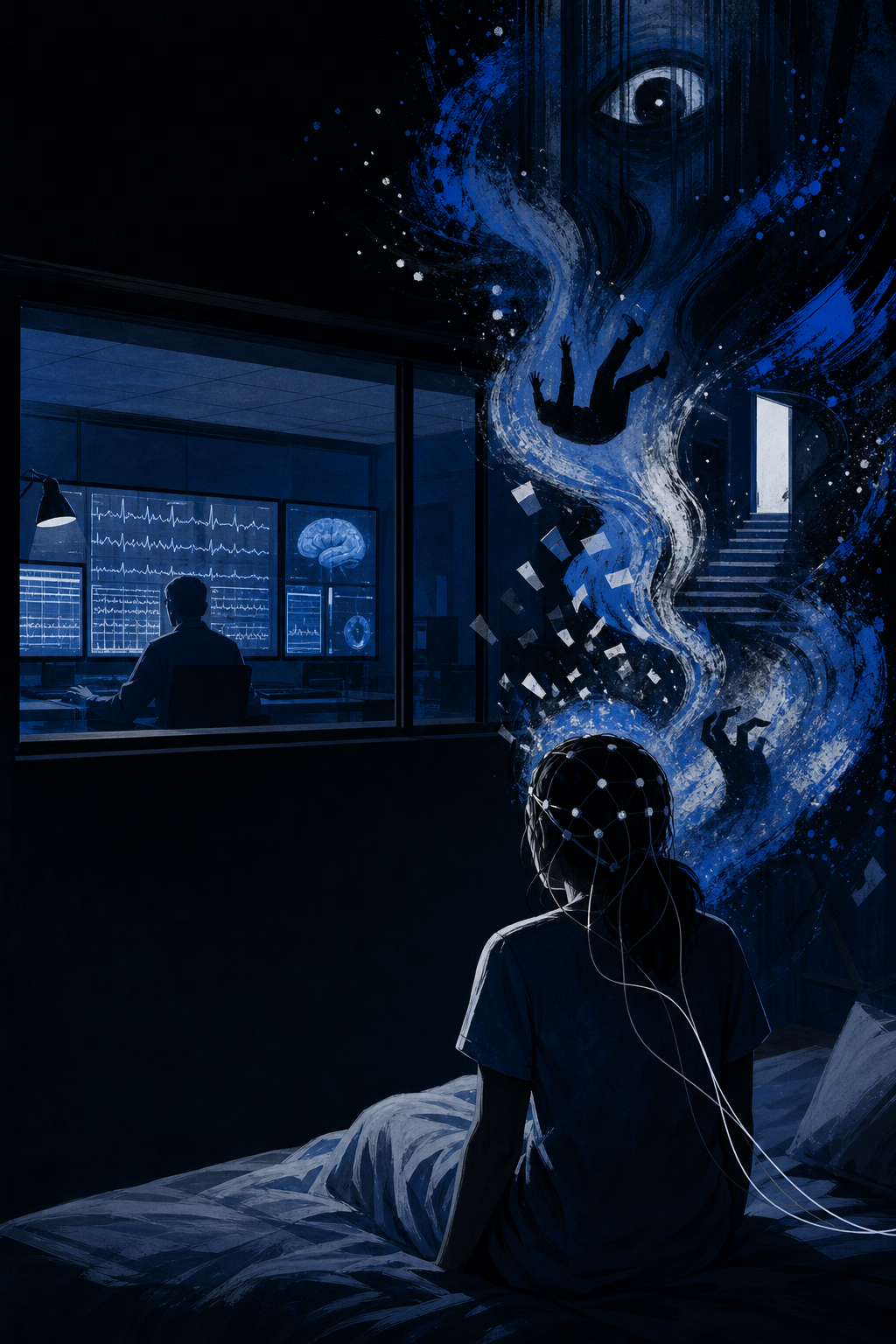
Chapter 4
The Service Door
By eight, Maya had written the night’s entry and opened Noah’s email three times without answering.
Woke at 4:47. Station dream. Alert. Returned to sleep after twenty minutes.
She had left the space below it blank.
Noah had not.
The director approved ten more days. Call me. Do not turn this into a negotiation with yourself.
She called from her kitchen.
— You got the extension.
— I got permission to move the final delivery, Noah said. You still have to decide what happens to the work.
— I can finish it.
— Not under the old plan.
Her laptop sat closed beside cold coffee. The audio piece was meant to be hers from first cut to final levels. She had built it from Rose Bell’s ledger, old laboratory sounds, and train announcements that now leaked into her sleep.
— What are you proposing?
— Shorter days. No overnight edits. Dana does the final level check.
— Dana changes things.
— Dana catches things. That is why she does final checks.
— And the installation?
— We present the version you have at the closing program. Or we pull it.
Pull it. The word landed hard.
— If I keep working, I want the piece to be mine.
— It is yours.
— Not if someone else finishes it.
— It is still yours if someone makes sure you are not mixing at two in the morning after four hours of sleep.
Maya looked toward the bedroom. By day it was an unmade bed. At night, she approached it with terms and conditions.
— You think I can’t do it.
— I think you have been trying to prove you can while getting sick.
She wanted to argue. Instead she said, “I choose the final structure. Dana checks levels only. If she finds a problem, she flags it. She does not rebuild the piece without me.”
— Done.
— And I leave by six.
— Also done.
Her throat tightened. She had not lost the work. But she had given up the rule that she must carry every part alone.
At the clinic that afternoon, Arun read her diary without going straight to the nightmare descriptions.
— You have enough here to treat what is happening now, he said. The nightmares recur. You are afraid to return to sleep. Your work is affected.
— I understand that part.
— Good. Then I will not make you sit through another brain lecture.
Despite herself, she smiled.
He set a handout on the desk. “Imagery rehearsal is one option. While awake, you write a changed version of the nightmare and practice it. It is used for recurrent nightmares, including nightmare disorder and PTSD-associated nightmares. It helps some people. Results vary.”
— Is it supposed to tell me what the dream means?
— No.
— Make it stop?
— Not reliably or at once.
Maya touched the handout. “You said REM was an emotion switch.”
— I said it because it was memorable. It was also too neat. Arun leaned back. During REM, some executive and reality-monitoring systems may have less influence than when you are awake. Emotionally important material generated inside the brain may have more influence. That can make a nightmare feel urgent and convincing. It does not give the station a fixed meaning.
— So I practice lying to myself about a door.
— You practice another route through a repeated scene.
She described the service door: gray metal, no handle, an alarm rising behind it. Beyond it, she could hear a platform but never reach it.
— What changes? Arun asked.
— The door opens.
— And then?
She pictured light on concrete. A transit worker stood by a bench with a clipboard. Two people waited beneath a clear sign.
— It’s staffed, she said. Ordinary. Nobody is rescuing me.
— Keep that.
Her first rehearsal lasted less than five minutes. The door opened, then the platform slanted away. The worker turned his back. The alarm grew louder.
Maya shut the notebook.
— I can’t even control a version I made up.
— You are not being tested.
— It feels like one.
— Then write that down. Not as a grade. As information.
For several days, she practiced at her kitchen table before dinner. Sometimes the door opened. Sometimes it became a blank wall. Once she reached the platform and woke before she saw who waited there.
The nightmares continued.
On the sixth morning, after another locked-door dream, Maya threw the diary across the room. It struck the baseboard and fell open.
By noon she had retrieved it, but had not written in it.
At the clinic, Elise was labeling recordings in the control room.
— I think I’m done with the exercise, Maya said.
Elise looked up. “What happened?”
— It didn’t work. The dream came back. The door was locked. I woke up angry.
— One hard night?
— One hard night after several hard nights.
Elise nodded. “Fair.”
Maya waited for reassurance. Elise did not offer the easy kind.
— The study gave us useful information, she said. It did not give us a clean answer. Treatment can be like that. A difficult result does not prove the method is useless, and it does not prove you failed.
— You sound like Arun.
— I trained with him. I am trying to recover.
Maya laughed once, then covered her face.
Elise turned the monitor. Colored traces moved across it: old lines from Maya’s study, filed and stripped of drama.
— My job is to say what the data support, Elise said. Your diary supports that you are still having distressing nights. Arun should help you decide whether to adjust the practice or add other care. But do not quit because the nightmare scared you.
— You should say that at the exhibit.
— Elise is, Arun said from the doorway. She is joining the panel.
That evening, Maya arrived at the museum with her laptop and left it closed.
Dana had found a low hum under Rose’s page-turns. Maya fixed it before six. She did not stay to polish the final thirty seconds. The train announcement still faded into the sleep-study recording with a rough edge.
Noah met her near the gallery entrance.
— You can still pull it, he said.
— No.
— You sure?
— No, Maya said. But play it.
Visitors gathered around Rose’s ledger in its glass case. Maya’s title appeared on the wall.
Signals, Reports, and the Space Between
The piece began with paper moving through old rollers. An actor read Rose’s notes: an eye movement, an awakening, a dream report. Then came the modern recording: measured lines, a breath, a train announcement cut into fragments.
The sounds did not solve one another.
At the end came the rough seam Maya had heard. It was not large enough to change the piece. It marked where she had stopped when she said she would.
Noah did not congratulate her.
— You left at six.
— I did.
— That was difficult.
— Yes.
— Good.
Near dawn, Maya woke in the station again. The passage narrowed. The alarm rose. The service door stood ahead.
For a moment, she was certain it would stay locked.
Then she saw a thin line of light beneath it.
She woke before it opened.
Her heart raced. The apartment was still. She reached for the diary.
Woke before dawn. Station dream. Door showed light.
The old demand returned: find the cause, search the memory, do not go back.
Maya set down the pen. The light was not proof that the exercise had worked. It was not an answer hidden in the dream.
She pictured the staffed platform because she had practiced it. Then she lay back in the dark and gave herself several minutes.
Afterward, she added:
Returned to sleep.