Chapter 3
Hello, Chicago
The announcement came through the speakers: Obama would appear soon.
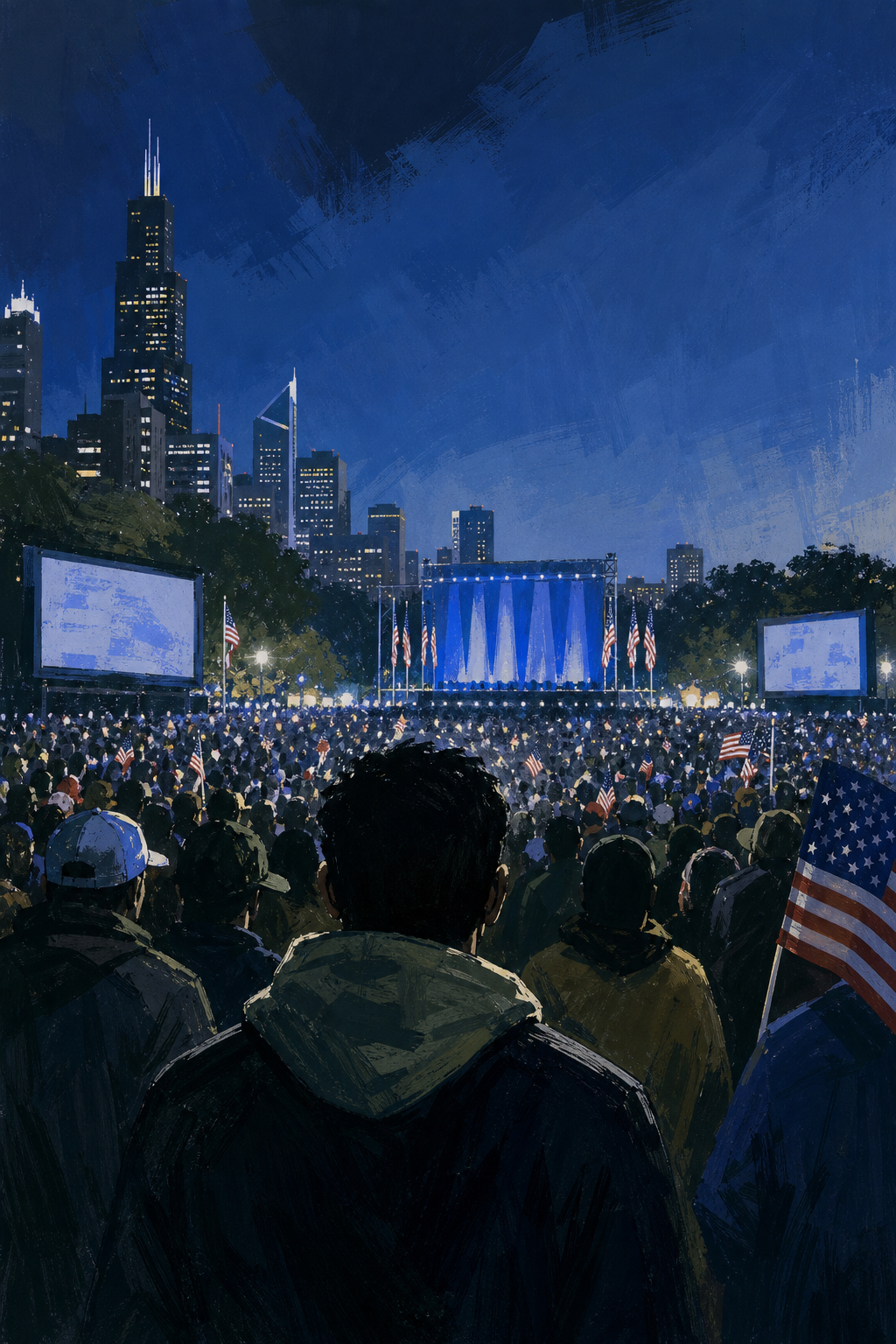
The crowd tightened without moving forward. People leaned toward the stage as if leaning could shorten the distance. Flags rose. Campaign signs bobbed over hats and shoulders. A woman near Cody climbed onto the edge of a low barrier until a security worker pointed her down again.
Cody lost sight of the stage completely.
The large screen remained visible, though only in pieces. A sign blocked it. Then someone lowered a flag, and there it was again: the blue backdrop, American flags, the lectern behind clear protective panels. Camera operators crossed the stage. Light shone on the empty space.
— Everybody got taller, Cody said.
Lena held her empty hot-chocolate cup between both gloves. “That happens at rallies. Very unfair to short people.”
— My knees have filed a complaint.
Marcus was trying to see around a man in a wide-brimmed hat. His phone rang. He answered, listened, then raised his voice.
— No, I can’t see him yet, he told his grandson. I can see the television screen. Does that count?
He listened again.
— No, you should be asleep.... Your mother is right.... I’ll tell you about it tomorrow.
He ended the call and tucked the phone into his coat.
— Reporters get a clear view, Cody said.
— They have a job, Marcus said.
— So do I. Mine starts at eight.
Lena looked at him. “You sent the message.”
— I know. I’m complaining for exercise.
His supervisor had replied only a minute earlier: See you then.
The plainness of it bothered Cody more than he expected. His job was still there in the morning. That was good. It was also a reminder that tonight had not changed the terms of his life. His visa still rested on employment, paperwork, and decisions made by people he would never meet.
The projection had made Obama president-elect in the language people used that night. The legal record would take longer. States would certify their results; presidential electors would vote on December 15; Congress would count those electoral votes on January 8. The final count would be 365 electoral votes for Obama and 173 for McCain. But none of that future paperwork could make Cody’s feet less cold in Grant Park, or tell him whether his own place in the country would become less fragile.
He rubbed his hands together.
Lena nudged his elbow. “You don’t have to prove you’re grateful for a job by looking miserable.”
— I’m not miserable.
— You have the face of a man waiting for a bus that will never come.
— I am waiting for a speech that may never come.
Marcus glanced toward the screen. “It’ll come.”
Cody did not answer. He had already chosen to stay. He had told his mother he would call after the speech, and he had told his supervisor he would report to work at eight. There was nothing left to settle. Still, the waiting pressed on him. The cold had reached his feet. The crowd kept shifting. Every time he found a gap between people, someone stepped into it.
Then the park roared.
The screen changed.
Barack Obama was walking toward the stage with Michelle Obama and their daughters, Malia and Sasha. The camera caught him holding Sasha’s hand. They moved together beneath the blue backdrop.
The noise around Cody broke into shouts, whistles, crying, laughter. A man behind him kept saying, “Oh, my God,” as if the words were the only ones available.
For a few seconds, the screen showed the whole family clearly.
Obama stopped.
He looked over the crowd.
Cody could not see the stage itself, only the image on the screen and the bright lights beyond the heads in front of him. But he could see that Obama did not rush to the lectern. He stood with his family while the noise continued.
The pause lasted only a moment. It felt longer because nobody in the park wanted to miss it.
— He’s looking at us, Lena said.
— At a hundred thousand hats, Cody said.
She gave a small laugh, but her eyes stayed on the screen.
Obama released Sasha’s hand and walked to the lectern. The crowd did not become quiet so much as more intent. People still shouted his name. Someone nearby blew a whistle. Then the first words came through the speakers.
— Hello, Chicago.
The answer from the crowd was louder than the greeting.
Cody felt it in his chest. He had expected something grander, some sentence built for posters by morning. Instead, Obama had greeted the city.
Marcus took off his knit cap.
Cody looked at Lena. She had one hand over her mouth.
— You all right? he asked.
She nodded too quickly.
— I’m fine, she said.
— You’re crying.
— I am not.
A tear ran down one cheek. Lena wiped it away with the back of her glove and looked annoyed at the glove for being there.
— I have spent all night telling people to be accurate, she said. Apparently accuracy does not prevent this.
Cody smiled. “Good. It would be a terrible rule.”
Lena looked at him, surprised.
— I mean it, he said. You can know what happened and still feel it.
For a moment she did not speak. Then she squeezed his arm through his coat.
On the screen, Obama began thanking the people who had worked for the campaign, the voters who had waited in lines, the families who had given their time and money. The speech reached Cody in clear parts and broken parts. A cheer covered a phrase. A woman beside him repeated a sentence to her husband because he had missed it.
Obama spoke of the victory as larger than one campaign. He spoke to people who had supported him and people who had not. When he said that change had come to America, the park erupted again. Flags shook in the air. Marcus closed his eyes briefly.
But Obama kept going. He warned that there would be setbacks and false starts. The road ahead would be hard.
Cody watched the screen. The words were not a promise about his job. They were not a promise about visas, rent, or the markets that had everyone at his office speaking in low voices. They did not make morning less real.
Still, he was glad Obama had said them.
— Not exactly a magic trick, Cody said.
— No, Lena said. Her voice was rougher now. Thank God.
He looked at her.
— If he stood up there and said everything was fixed, she said, I’d have to spend the next ten years explaining why it wasn’t.
— You were already planning lessons.
— I am always planning lessons.
Marcus smiled without looking away from the screen.
Obama spoke about the country’s troubles and the work required of its people. Cody did not catch every word. He caught enough: hardship, service, responsibility. The crowd listened. It was still a celebration, but people had stopped treating the speech like background noise for cheering.
Marcus held his cap against his chest.
— My grandson has a book of presidents, he said.
Cody remembered what Marcus had said during McCain’s concession: every face in the book belonged to the same old club.
— Tell him Obama said hello first, Cody said.
Marcus turned to him.
— Tell him that, Cody continued. Not that everything changed in one night. Just that he came out with his family, looked at the crowd, and said hello. Your grandson can decide what it means when he’s older.
Marcus’s face tightened. Cody worried he had said too much.
Then Marcus nodded.
— That’s a better story than I was preparing, he said.
Lena looked from one man to the other. “He’ll probably ask why you were both out in the cold.”
— Because your grandfather is stubborn, Cody said.
— And because there were no chairs, Marcus added.
The three of them laughed. The laughter disappeared quickly into the crowd, but it eased something in Cody’s shoulders.
A few rows ahead, an older woman lifted a small American flag, then lowered it when the people behind her asked. A young man with a campaign button stood silent, his face wet with tears. Two strangers held each other’s hands. Cody did not know their names. He did not need to.
His phone vibrated in his pocket.
Mother, the screen said.
He looked toward the stage. Obama was still speaking. Cody wanted to answer. He also did not want to give her a rushed report over the roar of the park.
He typed: He is speaking now. I will call when it is over.
The reply came almost at once.
Stay warm. Listen.
Cody put the phone away.
Lena saw the gesture. “Your mother?”
— She says to listen.
— Smart woman.
— She has met me.
The speech moved toward its close. Cody heard the crowd answer each line, sometimes with cheers, sometimes with a quiet that made the next words easier to hear. He did not have a clear view of the stage. The screen showed him what he could not see directly. That was enough.
When the speech ended, the crowd did not break apart at once. People stayed where they were, talking into phones, hugging, waving flags. The stage lights remained bright. The blue backdrop and American flags seemed almost small after the size of the crowd’s noise.
Cody called his mother while Lena and Marcus waited beside him.
— He said there would be setbacks, Cody told her. And false starts. He said there was work ahead.
His mother was quiet.
— And? she asked.
— And it was good, Cody said. Not easy. Good.
— Did he say anything about visas?
Cody laughed softly. “No.”
— Then go to work tomorrow.
— I will.
When he ended the call, Marcus had put his cap back on. Lena had found a trash bin for the cups.
They began walking toward the edge of the park with the slow, careful movement of people leaving a crowded place. Cody carried the small flag he had been given earlier. Marcus kept his folded flag in his coat pocket.
Behind them, people were still chanting Obama’s name.
Cody looked back once at the distant stage.
— The first thing he did up there wasn’t a victory shout, he said.
Lena nodded. “No.”
— He stopped. He looked. Then he said hello.
Marcus walked between them, hands deep in his coat pockets.
— That was enough to remember, he said.
Cody faced forward again. His feet hurt. His job waited. His visa was still unresolved. Nothing in Grant Park had changed those facts.
But he had listened to the speech instead of asking it to solve him.
Ahead, Chicago’s lights stretched along the streets, steady and ordinary. Cody walked with Lena and Marcus toward them.