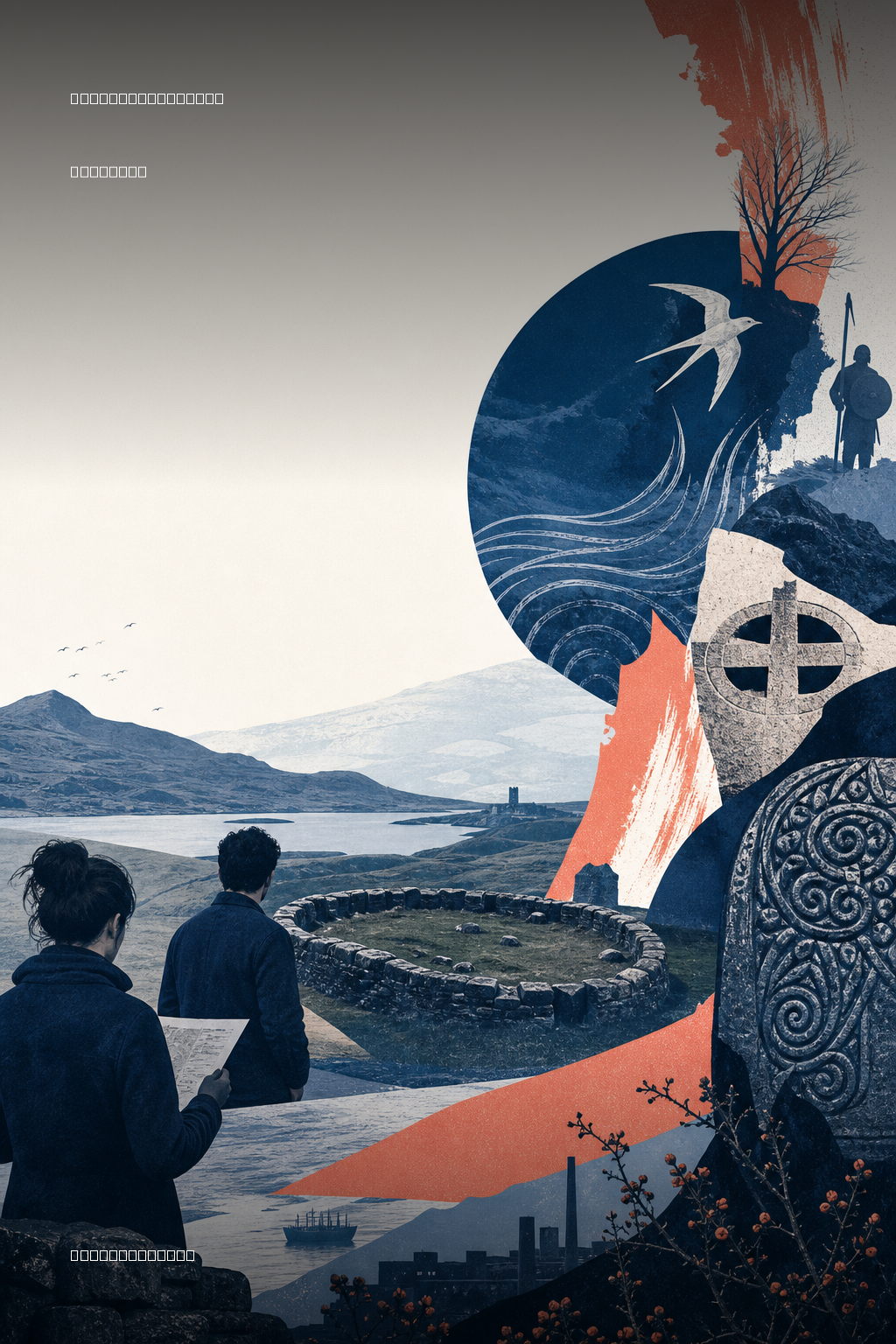
Chapter 3
Many Futures
Rain pressed against the hall windows as Aisling sorted the Keane family papers. Beneath a rent receipt, she found a petition, brown at the edges.
— A relief application, Ciaran said. For Brigid Doherty.
A schoolmaster had written it. At the bottom, Brigid had made a cross.
Aisling read: food requested; an ill sister; rent arrears; help for a brother’s passage if he had to leave.
The painted banshee leaned against the wall. Aisling had meant to place it behind the petition.
Ciaran saw her glance. “Don’t.”
— It would draw people in.
— To what? Her hunger as scenery?
Aisling put the painting face down.
For the display, they wrote a reconstruction from the petition and relief records.
Brigid stood outside the schoolhouse with her brother Tom. His coat hung loose. Inside, the schoolmaster warmed his hands over a small fire.
— Your age?
— Twenty-nine.
— Children?
— None. My sister has two, and she’s down with fever.
— The relief clerk will want the number in your household.
— He can have every number we own. Brigid set down a coin, meant for Tom’s fare to Liverpool. Write that there is no meal left after Saturday.
The man wrote carefully. He could make the request readable. He could not make relief arrive.
Outside, Tom said, “Keep the coin. I can wait.”
— You cannot. If he stayed, he might need food they did not have. If he left, she might never see him again.
The potato crop had failed, but the petition showed more than blight. Poor tenants depended on small plots and potatoes. Rent still came due. Disease spread through weakened households. Eviction and poor relief made every choice worse.
Brigid pushed the coin toward the schoolmaster. “Put it toward his passage. And write the rest.”
Back in the hall, Aisling placed the petition beside the Union panel. In 1801, the Act of Union ended the Irish Parliament and joined Ireland to the United Kingdom of Great Britain and Ireland. The Famine followed, from 1845 to 1852, in a society shaped by unequal landholding, poverty, insecure tenancy, and migration.
— We do not need six more objects, Ciaran said.
— We need people to understand how we got from this to 1998.
— Then give them a path.
They kept the petition, a short section on emigration, and a schoolchild’s folklore transcript. Aisling wrote a timeline: famine and mass migration changed families and politics. Later language activists, collectors, and Revival writers gathered, translated, and reshaped old tales for culture, pride, argument, and art. The stories had not arrived untouched from ancient times; people chose what to carry forward.
The transcript mentioned a púca by a roadside and a fairy fort near a field.
— This stays, Aisling said.
— It does, Ciaran replied. But not as a shortcut across fifteen hundred years.
— It records what was told when it was written down.
— Yes. That is plenty.
At the committee meeting, Mr Fraser read the final panel. It ran from the Easter Rising of 1916 to the Treaty of December 1921, then the Irish Free State in 1922. The Free State governed twenty-six counties; Northern Ireland remained in the United Kingdom.
— This partition section comes down, he said.
Eileen shifted in her chair. “The committee agreed on an exhibition about the fort.”
— The fort has been used to tell stories about the country, Aisling said. We cannot stop in 1847 because the next part is difficult.
Mr Fraser tapped the title. “Then you may have your political display. But not under the committee’s name, and not in this hall with our opening advertised.”
Without the committee, there would be no notices, parish list, or school buses.
Ciaran gathered the pages. “We can remove the panel.”
Aisling looked at Brigid’s cross. A history with no cost was decoration.
— No, she said. We keep it.
Eileen closed her folder. “Then I cannot stay as chair.”
Later, Moira found a notebook on the table. Someone had written across it: SUPERSTITION IS NOT HISTORY.
She rubbed the ink. “Mrs Donnelly told that one after funerals. Not to prove anything. She sat with the family until the kettle boiled.”
— I thought putting it in the case would protect it, Aisling said.
— It might. Or people might fight over it. Put it in because people told it, if you like. That is different.
On 10 April, the radio announced the Good Friday Agreement. It offered a new framework for relationships within Northern Ireland, across Ireland, and between Ireland and Britain. No one mistook it for an ending.
The opening was small. No school buses came.
Aisling changed the sign above the door to THE FORT AND ITS MANY STORIES. She read Moira’s notebook as a twentieth-century family telling. Ciaran showed the fort plan: an enclosed settlement or farmstead, not a proven fairy dwelling.
Then he pointed to the cases. Archaeology showed material life. Religious writings showed Christian claims. Medieval myths showed learned imagination. Folklore records showed what people told when they were collected.
A child studied the timeline. “Can the fort have more than one story?”
Moira smiled. “It has managed so far.”
Outside, the fort’s banks stood dark in the field: measurable earth, carrying meanings no single label could hold.