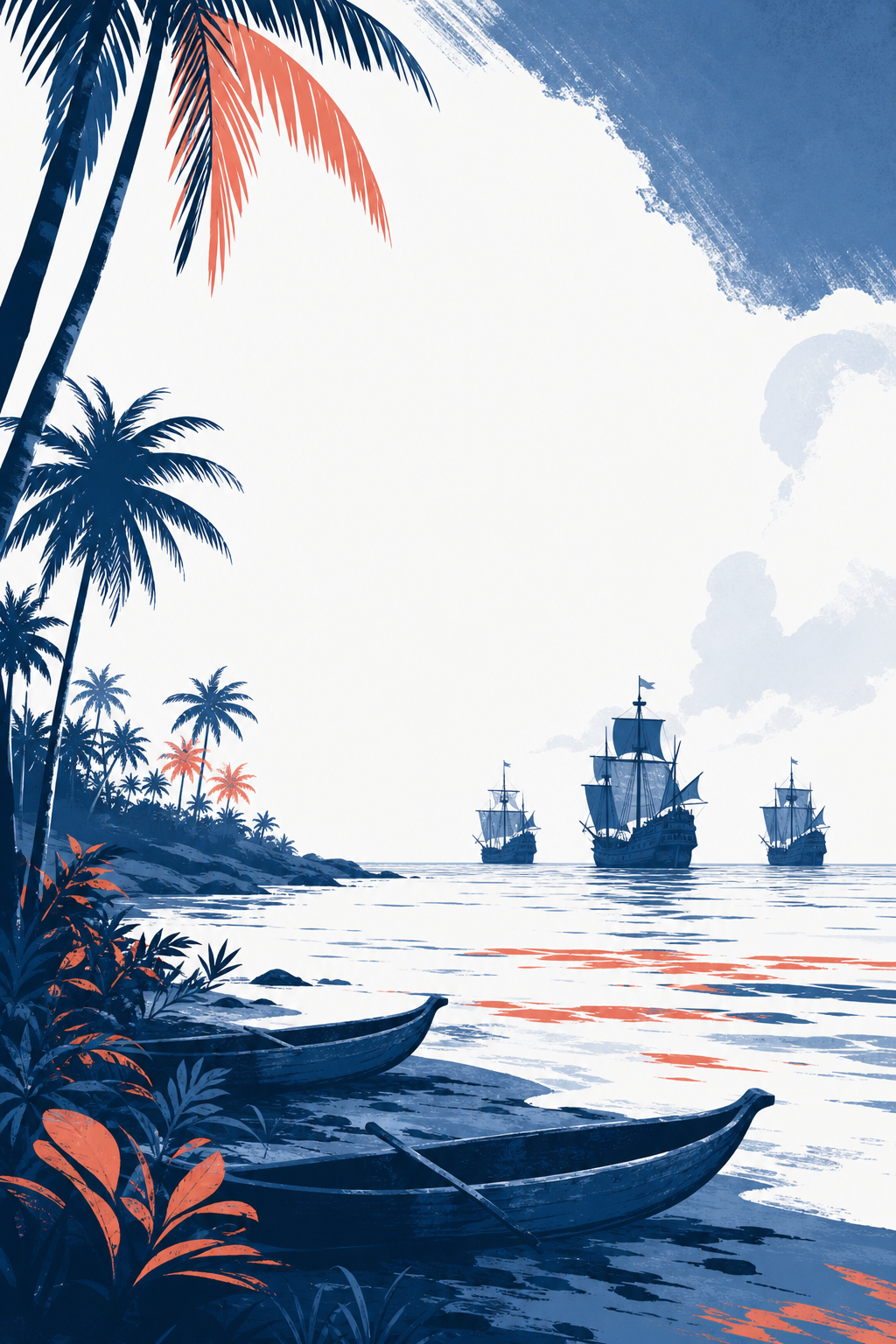
Chapter 4
The Shore Remains Named (Approx. 1,200 words)
Iria was mending a fishing net when the canoe came in from the west.
Oru saw it first. He stopped scraping a paddle and shaded his eyes.
— One man, he said. No trade bundles.
The traveler stepped into the shallows with his shoulders bent from paddling. Iria gave him water before she asked a question.
— The ships have gone from Hispaniola, he said. Their leader sailed away. Men remain at the place built from the broken ship.
— La Navidad, Oru said.
The traveler nodded. “They ask for cassava, fish, men to carry wood, and guides for inland paths.”
Iria held the wet net cord tightly. “Did you see the people taken from here?”
The traveler looked at the sand.
— I did not.
It was not the answer she wanted. It was the only one he had.
That night, people gathered near the cooking fire. The traveler described the wooden buildings at La Navidad, the tools, and the weapons at the men’s belts. He described men pointing at baskets of food, then toward the paths leading away from the shore.
Reports from different places did not always match. One community had seen Castilians offer cloth. Another had given food and then been asked for more. A man from a nearby island said the settlers were few and hungry.
Meya looked across the fire at him. “Few men with weapons are still men with weapons.”
— What goes into the next warning? she asked Iria.
Naku sat close beside his sister, listening.
Iria looked at the traveler’s tired face. “Say what you saw. Men stayed at La Navidad. They ask for food, work, guides, and routes. They carry weapons.”
— And the reports we cannot prove?
— Say where they came from. Do not make them larger.
Oru nodded. “If one messenger brings a false certainty, people may stop listening when the next one brings the truth.”
Iria tied a short piece of repaired net beneath the traveler’s water gourd. It was not a sign known everywhere. It would tell the person who had sent him onward that he had spoken with Iria of Guanahani, whose palm still bore a pale mark from the Castilian bell.
— Tell them this too, she said. The strangers asked us about gold and other islands. Then they took people aboard. Keep children close. Do not let one person go with them because they offer a bright thing.
The traveler repeated the message. Iria made him say it again, more slowly.
At dawn, Oru watched the canoe leave.
— You have given him a heavy load, he said.
— It is words.
— Words make poor paddles. They still tire a person.
Iria bent over the net. “He asked for the message.”
— Yes. Oru picked up his paddle scraper. And you gave him one he can carry.
Months later, news crossed the sea that Columbus had returned to Castile. On 15 March 1493, he reached Palos carrying captive Indigenous people. He still believed he had reached islands near the Indies, not lands unknown to Europeans.
His voyage was later called the “discovery of America,” but the name hides what was already true: Guanahani, Hispaniola, and the wider Americas had been inhabited for millennia. Columbus had reached particular Caribbean communities and claimed opportunities for Castile.
Then came news of another departure. On 25 September 1493, Columbus began a second expedition with seventeen ships and a much larger colonial force.
Iria did not know when those ships would appear again, or where. She knew what three had done.
On Hispaniola, Yarima was sorting dried fish when Aroa returned.
He had been gone long enough for beard to shadow his jaw. Fresh scratches marked one side of his canoe.
— You took the long water, Yarima said.
— I took water that did not pass their houses.
Her brother came from the bohío. “Did anyone follow?”
— I saw no canoe behind me.
Yarima gave him a look.
Aroa sighed. “I know. That does not mean no one watched.”
He handed her his water gourd. Beneath its rim was a small knot of repaired net.
— The woman from Guanahani sent this, he said. Her name is Iria.
Yarima turned the dark cord between her fingers. The repair was neat and tight.
Aroa repeated Iria’s words without adding anything of his own. People had been taken aboard the Castilian ships. The strangers had asked about gold, islands, and routes. Men remained at La Navidad and wanted food and guides.
Yarima’s brother rubbed his forehead. “They asked again this morning for a canoe and two guides. East along the coast.”
Aroa glanced toward the trees. “They saw me come from that direction.”
— They see every canoe now, Yarima said.
Her brother lowered his voice. “If they learn the sheltered inlet behind the mangroves, they will use it. It is the quickest way to your sister’s household.”
The inlet was also Aroa’s route home. A narrow channel ran through shallow water and mangrove roots. Families used it when the open coast was rough. It carried fish, cassava, and visits between kin.
— If I go by the outer coast, Aroa said, the eastern households wait longer for news.
— And if you use the inlet? Yarima’s brother asked.
— Then the Castilians may learn it.
Yarima looked down at Iria’s net cord. Someone she had never met had sent a warning across water, trusting strangers along the route to carry it honestly. Now the answer could not stay in Yarima’s hand.
— Use the inlet once more, she said.
Her brother stared at her.
— Aroa leaves before dawn. He takes the warning north and carries this answer to Iria: the men at La Navidad are asking for guides and watching canoe landings.
— And afterward? Aroa asked.
— Afterward, we stop using the inlet for a time.
Her brother looked toward the bohío, where baskets held cassava and beans. The inlet shortened the trip to gardens and fishing grounds. Without it, food would take longer to move between households.
— You are closing our easiest route.
— For now.
— For a message?
— For people who need to know the men are looking for paths.
Her brother let out a breath. “You could have said that first.”
Before sunrise, Yarima helped Aroa load water, dried fish, and cassava cakes. She did not give him a list of gardens or springs. He received only the food and directions needed for the journey.
At the mangrove passage, Yarima watched him push into the narrow waterway. When his canoe disappeared among the roots, she pulled the palm marker from the bank and carried it home.
The inlet was still there. The water still moved beneath the trees. But her household would not point anyone toward it.
The choice did not remove La Navidad. It meant longer paddling, fewer visits, and harder work carrying food by other routes. It gave Aroa time to take the warning onward.
The surviving European accounts do not record what Iria or Yarima thought. No contemporary written testimony from a Lucayan or Taíno witness survives. Their lives in this story are fictional, built carefully from archaeology, Caribbean Indigenous scholarship, and European records that served European aims of profit, conversion, information, and possession.
What is documented is that the danger grew. In the following decades, disease, forced labor, enslavement, violence, displacement, and social disruption devastated Caribbean Indigenous communities.
That devastation did not end Indigenous life.
On Guanahani, Iria heard a canoe call from beyond the reef and went down to the water. On Hispaniola, Yarima set aside cassava for the next traveler, though the journey would now take longer.
The canoe crew named the island Guanahani as they passed.