Chapter 3
After the Door Is Shut
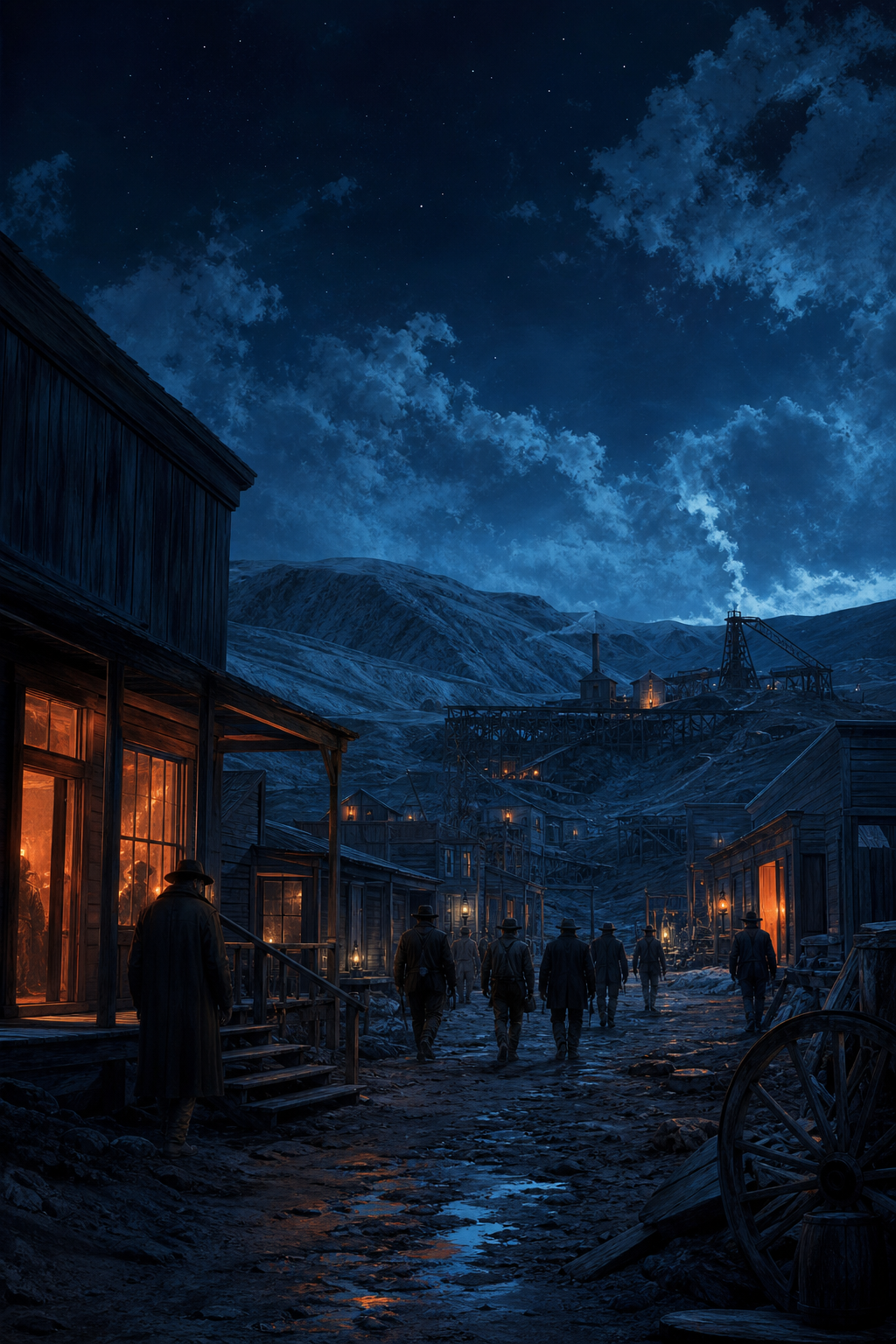
Ada stepped from the saloon and tested the road with her boot.
Mud filled the wagon ruts. The top had stiffened in the cold, but the ground beneath was still soft. Her heel slid. Lin caught her elbow before she went down.
— Walk where the wheels packed it, he said.
— I was trying to.
— You were trying where it looked level.
Tom came out behind them. He stood close to the wall, his face set toward the door Ellis had just shut.
— My money may be in there, he said.
Ada turned on him. “Your money is gone.”
— I might have dropped a coin.
— You might have. That does not make the faro man a thief.
Tom looked past her, toward the saloon door.
Ellis came out carrying his coat. Mara had remained inside with the cook to finish the work of closing the room. Ellis pulled the door fast behind him and checked the latch.
— I’ll walk with you as far as the hotel crossing, he said.
— You have a business to secure, Ada told him.
— I do. I also have a customer who may decide to return through my door before I finish.
Tom gave a bitter laugh. “You think I cannot walk home.”
— I think you can, Ellis said. I do not yet know whether you mean to.
Lin shifted his parcel under his arm. “We should move before the road gets busier.”
It was not busy in the way the saloon had been. No crowd pressed around them. But people still crossed the dark street in ones and twos. A man hurried toward a hotel with his coat buttoned to the throat. Two women passed in the other direction, speaking quietly. A horse stood near a store, its breath white in the cold. From an open doorway farther down came the smell of cooked meat.
Lin pointed northwest. “We go that way, then uphill.”
Tom shook his head. “My boardinghouse is south of the mine road.”
— The direct way is cut to pieces by wagon wheels.
— It is shorter.
— It is worse, Lin said. You may choose short or you may choose dry. You do not get both.
Tom’s mouth tightened, but he followed.
They had gone less than half a block when someone called from the hotel porch.
— Price?
A broad-shouldered man came down the steps, favoring his left hand as he buttoned his coat. Ada knew him after a moment. Jonah Reed had worked in the mine with Tom until an old hand injury pushed him into hotel work. He and Tom had once shared a room near the shaft road. Lately Jonah had carried plates and water in the dining room rather than swinging tools underground.
— I saw you headed toward Ward’s earlier, Jonah said. Thought I might find you coming back foolish.
Tom looked at him. “You came out to inspect me?”
— I came out because my room is uphill and this is my road. Jonah looked at Ada, then Ellis. What happened?
— Faro, Ada said.
Jonah’s face showed no surprise. “Ah.”
Tom bristled. “Do not start.”
— I have not said anything.
— You did not need to.
A wagon turned from the cross street. Its wheels struck the packed center of the road, then slid toward the softer edge. The driver hauled the reins. The horse tossed its head and snorted.
— Back, Lin said.
They moved against the wall. Jonah caught Tom’s sleeve when Tom stepped the wrong way. The wagon passed close enough to throw mud across Ada’s skirt.
Tom yanked free. “Stop pulling at me.”
— Then watch where you stand, Jonah said.
Tom stepped toward him.
Ada put herself between them. She could smell whiskey on Tom’s breath, though he had not had enough to fall. He was tired, angry, and looking for a place to put it.
— Not him, she said.
— You think I want to fight Jonah?
— I think you want someone to blame.
His face changed. For a moment he looked younger than twenty-four, younger than the mine dust in his hands and the hard wages in his pocket.
A shout rose somewhere beyond the buildings. Another voice answered. The wind took the words before they reached them.
Tom turned toward the sound. “That could be the man from the table.”
— It could be anyone, Ellis said.
— If he is there—
— You will do what? Ada asked. Accuse him again in the road?
Tom did not answer.
Lin moved them into the lee of the building. “We wait a moment.”
— I have to work tomorrow, Tom said.
— Yes, Ada replied. And you are spending the night making that harder.
The cold settled through her gloves. Jonah rubbed his injured hand against his coat. Ellis watched the street without speaking.
The voices faded. A door shut somewhere uphill.
Lin looked at Tom. “There are two ways from here. One goes by the rooms where men keep gambling after other places have shut. The other goes toward your boardinghouse.”
Tom stared into the dark.
Ada knew what he wanted: to find the faro player, demand the lost money, and return with a story that made sense of his shame. If she grabbed him, he would fight her. If she followed him, she would be helping him choose the worst road.
She stepped aside.
— I will not drag you, she said. But I will not go looking for him with you. Jonah will not. Mr. Ward has a business to return to. Lin has a delivery. Choose.
Tom looked from her to the road. His fists opened and closed.
For several seconds, nobody moved.
Then Tom said, “The boardinghouse.”
Jonah let out one breath through his nose. “A fine discovery.”
— Do not make it sound noble, Tom said.
— I would not know how.
They went uphill.
At the edge of Chinatown, the buildings stood farther apart. Light showed through a few windows. A man carried split wood from one doorway to another. Behind a wall came the sound of bowls and voices. Lin guided them around a stretch of ground torn up by wheels and runoff.
— Here, he said. Stay near the boards.
Tom obeyed this time.
Ada noticed it because he did not look at Lin when he did.
— You know every bad patch in town, she said.
— I deliver goods, Lin replied. A person learns what people need, and where the roads punish him for carrying it.
— What is in the parcel? Jonah asked.
— Tea, thread, and lamp oil.
— For whom?
— For a woman who paid before sunset and will remember if I am late.
Ada almost smiled.
They passed behind several businesses. Two men were unloading sacks from a wagon. Farther uphill, a boardinghouse door opened. Warmth spilled across the porch, then narrowed when someone stepped out.
A miner raised a hand. “Price. You coming in? Cook saved stew.”
Tom stopped.
The man looked at Ada and the others, then seemed to understand enough not to ask questions. “It will not improve waiting.”
He went back inside.
Tom stayed where he was.
Ellis looked down the road toward his saloon. “This is as far as I can come.”
Ada faced him. Until that night she had thought of Ellis chiefly as a man who profited when tired miners spent badly. Now he had refused Tom another drink, shut his own room early, and stood in the mud when he could have returned to his cash and bottles.
— Thank you, she said.
Ellis gave a brief nod. “Get him inside.”
Then he looked at Tom. “Tomorrow, if you want to speak about the coin Mara found, you can do it sober. Not tonight.”
Tom swallowed. “All right.”
Ellis left downhill.
Tom watched him go. Then he put a hand into his coat pocket and brought out the coins that remained. There were fewer than Ada had hoped to see.
— Take these, he said.
Ada did not reach for them. “Why?”
— Because I do not trust myself with them tonight.
Jonah looked away, giving him the small privacy he could.
Tom held the coins out. “Keep them until I work another shift.”
— That is not the same as making me your keeper.
— I know. His voice was rough. I am asking you to hold them. Not decide for me.
Ada took the coins. They were cold in her palm.
— I will hold them, she said. We will speak after your shift.
Tom nodded.
He started toward the porch, then stopped. “Ada.”
— What?
— I was wrong about the game.
She waited.
— I lost, he said. That is all.
It was not a full apology. Not yet. But it was the truth he had fought all night to avoid.
— Go eat your stew, Ada said.
Jonah took his arm, not roughly this time. Tom let him. They went inside together.
Lin waited beside Ada until the door closed.
— You are returning alone? he asked.
— Yes.
— That was not my question.
She looked at him.
He pointed downhill. “Stay on the packed road. Do not trust smooth-looking ground.”
— I will try not to insult it.
— That is wise. The road does not care.
They parted at the crossing. Lin went toward his delivery and home. Ada turned toward the boardinghouse where she worked.
Behind her, rooms still held meals, work, cards, arguments, sleep, and people making their separate ways through the cold. Her boots found the firm center of the road when she could see it. When she could not, she slowed.
Bodie had several thousand residents in its boom years, though no one figure tells the whole story. Its dark streets, hard-rock mines, crowded businesses, and many saloons are documented. This particular closing, the walk home, and Ellis’s private routines are a fictional reconstruction of one possible night.